Angkor Wat did not stay the same religion forever.
That might sound strange at first because most people think of Angkor Wat as one fixed thing. Big temple. Sunrise photos. Ancient stones. Done.
But its religious story is much more layered than that.
Angkor Wat began in the 12th century as a Hindu temple dedicated to Vishnu. Over time, it became a Buddhist shrine, and today it is still one of Cambodia’s most powerful religious and cultural symbols.
That change did not happen overnight. It was gradual, messy, human, and shaped by kings, monks, politics, trade, worship, and ordinary people doing what people always do with sacred places. They kept using it, adapting it, and giving it new meaning.
That is what makes Angkor Wat so fascinating. It is not just a monument from the past. It is a sacred site that changed with Cambodia itself.
Key Takeaways
- Angkor Wat was built in the 12th century under King Suryavarman II.
- It was first dedicated to Vishnu, one of the main gods in Hinduism.
- The temple layout reflects Hindu ideas about Mount Meru, the mythical home of the gods.
- Buddhist influence grew in the Angkor region from the late 12th century onward.
- Angkor Wat slowly became a Buddhist shrine rather than changing all at once.
- Many Hindu carvings and symbols remain visible today.
- Buddhist statues, rituals, and worship were added over time.
- Today, Angkor Wat is both a tourist site and a living religious place.
A Simple Timeline of Angkor Wat and Religion
| Period | What Happened | Main Religious Link |
|---|---|---|
| Early 12th century | Angkor Wat was built under Suryavarman II | Hinduism |
| 12th century | The temple was dedicated to Vishnu | Vishnu worship |
| Late 12th century | Jayavarman VII promoted Buddhism across the Khmer Empire | Mahayana Buddhism |
| 13th to 16th centuries | Theravada Buddhism became more common in Cambodia | Theravada Buddhism |
| After the early 15th century | Angkor declined as a royal centre, but monks kept Angkor Wat active | Buddhist worship |
| Today | Angkor Wat remains sacred to Cambodians and visited by people from around the world | Buddhist and cultural identity |
Angkor Wat Was First Built as a Hindu Temple
Angkor Wat started as a Hindu temple.
King Suryavarman II built it in the early 12th century, during one of the most powerful periods of the Khmer Empire. The temple was not just a place for prayer. It was also a huge statement of royal power, religious devotion, and artistic skill.
And yes, it was massive on purpose.
Angkor Wat was designed to show the king’s link with the divine. In ancient Khmer belief, kings were not seen as ordinary rulers in the modern sense. Their power was tied closely to religion, the gods, and the idea of cosmic order.
So when Suryavarman II built Angkor Wat, he was not just building something pretty for visitors to admire 900 years later while sweating through their shirts. He was creating a sacred royal monument.
The temple was dedicated to Vishnu, a major Hindu god often linked with protection, order, and the preservation of the universe.
Why Vishnu Mattered at Angkor Wat
The dedication to Vishnu is one of the biggest clues to Angkor Wat’s original religious purpose.
Many earlier Khmer temples were linked more closely with Shiva. Angkor Wat stood out because of its strong connection to Vishnu. That choice mattered because it showed the king’s religious focus and helped shape the artwork, layout, and meaning of the temple.
You can still see that Hindu identity in the carvings today.
Some of the most famous scenes at Angkor Wat come from Hindu stories, including the Ramayana and Mahabharata. These are not small decorations added for fun. They are giant stone stories carved into the galleries, showing gods, demons, kings, battles, heavens, and underworlds.
Basically, Angkor Wat was a temple, a royal monument, and a stone picture book of sacred Hindu ideas all rolled into one. Not exactly a quick weekend DIY project.
Hindu Symbolism Built Into the Temple
Angkor Wat’s design is full of Hindu meaning.
The five central towers are usually understood as a symbol of Mount Meru, the sacred mountain at the centre of the universe in Hindu belief. The huge moat around the temple can be read as the cosmic ocean surrounding that mountain.
That sounds poetic, but it also tells you something practical about how the temple was meant to be experienced.
As you move from the outer areas toward the centre, the temple rises higher. You pass through galleries, courtyards, steps, and towers. It feels like you are moving from the human world toward the world of the gods.
That physical climb was part of the meaning.
The temple was not designed only to be looked at. It was designed to make you feel the distance between everyday life and sacred power.
Hindu Art You Can Still See Today
Even though Angkor Wat later became a Buddhist site, much of its Hindu art survived.
You can still see carvings that show scenes from Hindu mythology. One of the best-known examples is the Churning of the Ocean of Milk, where gods and demons pull on a giant serpent to churn the cosmic sea.
It is dramatic, busy, and honestly a little wild when you really look at it.
You can also find scenes linked to Vishnu, armies, divine beings, and mythic battles. These carvings matter because they show that Angkor Wat’s Buddhist story did not erase its Hindu past.
Instead, the site became layered.
That is one of the big things to understand. Angkor Wat did not stop being historically Hindu just because it later became Buddhist. Both stories are part of the same place.
How Buddhism Entered the Story
Buddhism was present in the Khmer world before Angkor Wat changed, but its role grew stronger over time.
A major turning point came with King Jayavarman VII in the late 12th century. He was one of the most famous Khmer kings, and he strongly supported Mahayana Buddhism. He built major Buddhist monuments, including Bayon at Angkor Thom.
That did not mean Angkor Wat instantly changed the moment he came to power.
Real religious change is rarely that neat.
Think of it more like a slow shift across society. Royal support helped Buddhism grow. Monks became more active. New religious ideas moved through the region. Local people kept worshipping, adapting, and blending old and new practices.
Over time, Angkor Wat became more closely linked with Buddhist worship.
From Mahayana Buddhism to Theravada Buddhism
There is another layer here.
Jayavarman VII is linked with Mahayana Buddhism, but Cambodia later became mainly Theravada Buddhist. That is the form of Buddhism most closely tied to Cambodia today.
Theravada Buddhism spread widely through mainland Southeast Asia, including Cambodia, Thailand, Laos, and Myanmar. Its growth was helped by monks, trade routes, regional contact, and changing political life after the peak of the Khmer Empire.
By the post-Angkor period, Angkor Wat was no longer mainly understood as a royal Hindu temple. It had become a Buddhist sacred site.
This is why you need to be careful with simple claims like Angkor Wat changed from Hindu to Buddhist in the 15th century. That is not completely wrong, but it is too tidy.
The better way to say it is this.
Angkor Wat was built as a Hindu temple in the 12th century, gained Buddhist meaning over time, and became an active Buddhist shrine as Cambodia’s religious life changed.
Why the Religious Change Happened
There was no single reason Angkor Wat became Buddhist.
Several things were happening at once.
- Khmer kings supported different religious traditions at different times.
- Buddhist monks became more active in Cambodia and nearby regions.
- Trade and travel helped religious ideas move across Southeast Asia.
- The Khmer Empire changed politically after its strongest period.
- Local people adapted old sacred places for new forms of worship.
That last point is key.
People do not always abandon sacred places when religion changes. Often, they keep the place and change how they use it.
That is what happened at Angkor Wat.
The temple already felt sacred. It already had huge symbolic power. It already stood at the heart of Khmer memory. So instead of becoming useless when religious life changed, it gained new meaning.
Honestly, that is part of why Angkor Wat survived so well. A temple that stays sacred tends to be cared for. A forgotten building has a much harder time.
What Changed Inside Angkor Wat
As Angkor Wat became a Buddhist shrine, parts of the temple were adapted for Buddhist worship.
Buddha images were added. Some Hindu images were altered or replaced. Certain areas were used for prayer, offerings, and rituals in new ways.
One of the most powerful things about Angkor Wat is that these changes did not fully wipe away what came before. You do not walk through Angkor Wat and see a clean break between Hindu and Buddhist history.
You see overlap.
You see Hindu carvings near Buddhist images. You see a temple built around Hindu cosmic ideas being used by Buddhist worshippers. You see stone, faith, politics, memory, and time all stacked together like layers of an ancient cake.
A very dusty cake, but still.
What Stayed Hindu
Many Hindu features stayed in place.
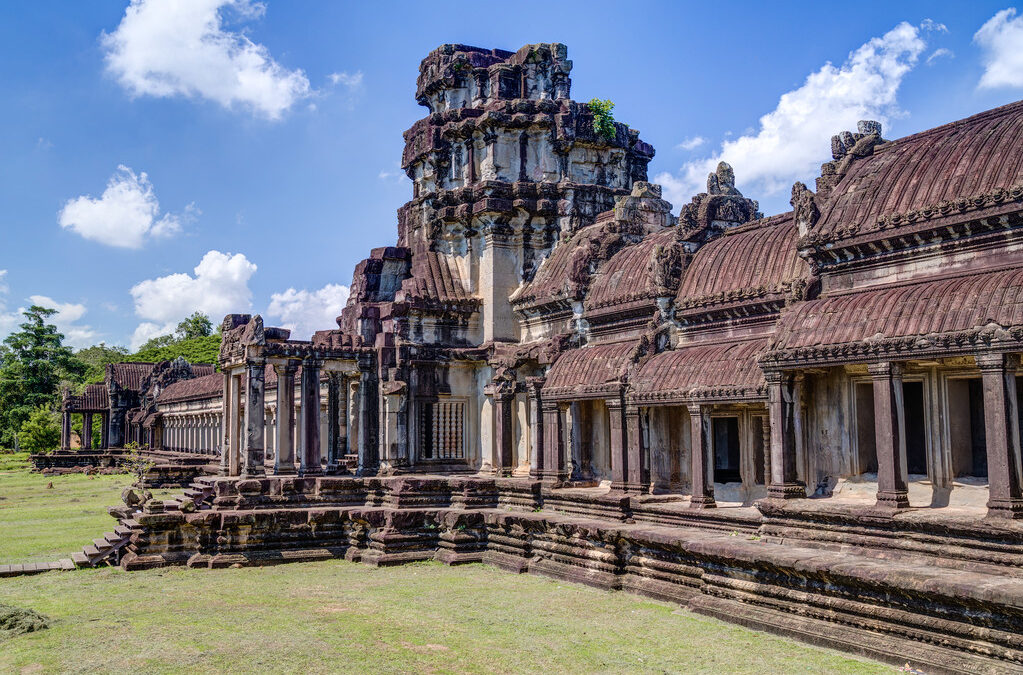
The overall layout of Angkor Wat still reflects the sacred mountain idea. The moat still surrounds the temple. The towers still rise from the centre. The galleries still hold great Hindu carvings.
These parts were not removed just because Buddhist worship grew.
That matters because it shows how Angkor Wat’s religious identity became blended rather than fully replaced.
Visitors today can still read Angkor Wat as a Hindu temple in its original design. At the same time, they can also see it as a Buddhist shrine in its later and modern use.
Both readings are true.
What Changed in the Artwork
Some of the clearest signs of religious change are found in the temple’s images.
In parts of Angkor Wat, Buddhist figures were added to existing spaces. In some cases, older Hindu images were changed. In other places, Hindu scenes remained untouched.
This creates a mix that can feel confusing if you expect one temple to equal one religion.
But Angkor Wat is not that simple.
Its walls show the Hindu world of the Khmer Empire. Its later statues and worship spaces show the Buddhist faith that became central to Cambodian life.
That mix is not a flaw. It is the whole point.
Spiritual Coexistence at Angkor Wat
Angkor Wat is a strong example of religious coexistence.
This does not mean everything was always peaceful or simple. History rarely behaves that nicely. But it does mean the temple became a place where older Hindu meanings and newer Buddhist practices could sit side by side.
For Cambodian worshippers, sacred power did not always need to fit into clean categories. A place could hold memory, ancestors, gods, Buddhas, kings, and national pride all at once.
That can feel unusual if you are used to thinking of religions as separate boxes.
At Angkor Wat, the boxes overlap.
Angkor Wat After the Decline of Angkor
In the early 15th century, Angkor declined as the main royal centre of the Khmer world.
Many temples in the wider Angkor region were neglected over time, but Angkor Wat continued to matter. Theravada Buddhist monks helped keep it active as a place of worship and pilgrimage.
This is one of the reasons Angkor Wat remained so well known compared with many other temples in the region.
It was not only a ruin hiding in the forest.
It was still sacred.
People prayed there. Monks stayed connected to it. Visitors came to see it. Later, international interest grew even more during the French colonial period and beyond.
Angkor Wat as a Living Buddhist Shrine Today
Today, Angkor Wat is not just an archaeological site.
It is also a living religious place.
You may see monks in saffron robes, local people offering incense, visitors bowing before Buddha images, and quiet prayers happening near busy tourist paths.
That mix can feel strange at first.
One person is trying to take the perfect sunrise photo. Another person is making a sincere offering. A tour guide is explaining bas-reliefs. A monk is walking past like this is all very normal because, to him, it probably is.
That is Angkor Wat.
It is history, worship, tourism, identity, and daily life happening in the same space.
Why Angkor Wat Matters to Cambodian Identity
Angkor Wat is one of the strongest symbols of Cambodia.
It appears on the Cambodian flag, which already tells you a lot. Countries do not put random buildings on their flags because they look nice. Angkor Wat represents cultural pride, historical memory, and national identity.
For many Cambodians, Angkor Wat is tied to both ancient Khmer greatness and living Buddhist devotion.
That is a powerful combination.
It connects the past to the present. It links kings and monks, empire and modern nation, stone towers and daily prayers.
Few places carry that much meaning without collapsing under the weight of it. Angkor Wat somehow manages it.
What Visitors Can Look For
If you visit Angkor Wat, you can spot its religious layers if you know where to look.
Start with the structure itself.
Look at the moat, the causeway, the rising galleries, and the central towers. These are tied to the temple’s original Hindu design and the idea of Mount Meru.
Then look at the carvings.
You’ll see Hindu stories, divine beings, battles, and royal scenes. The bas-reliefs are not just decoration. They are one of the best ways to understand what the temple meant when it was first built.
Then look for Buddhist features.
You may see Buddha statues, offering areas, incense, monks, and active worship. These show how the temple continued to live after its original Hindu purpose changed.
The trick is not to ask whether Angkor Wat is Hindu or Buddhist.
The better question is how it became both.
Common Myths About Angkor Wat’s Religious History
Myth One Angkor Wat Was Always Buddhist
No. Angkor Wat was first built as a Hindu temple dedicated to Vishnu.
Its Buddhist role came later, through a long process of religious change in Cambodia.
Myth Two Buddhism Erased the Hindu Temple
Not really.
Buddhist worship changed the temple, but it did not erase all Hindu features. Many Hindu carvings, symbols, and design ideas remain clearly visible.
Myth Three The Change Happened in One Year
No again.
The change happened gradually over centuries. Different forms of Buddhism grew in influence at different times, and Angkor Wat’s meaning changed along with Cambodian society.
Myth Four Angkor Wat Is Only a Tourist Attraction Now
Definitely not.
It is a major tourist site, but it is also still sacred. People still pray there, make offerings, and treat it as part of Cambodia’s living religious life.
Why This Religious Transformation Matters
Angkor Wat’s religious transformation matters because it shows how culture really works.
It is not always clean. It is not always simple. It does not always move in straight lines.
A Hindu temple can become a Buddhist shrine. A royal monument can become a national symbol. A place built for one kind of worship can hold many layers of meaning centuries later.
That is what makes Angkor Wat more than just an impressive building.
Its stones tell a story about power, belief, adaptation, and survival.
And the best part is that you can still see that story with your own eyes. It is there in the towers, the carvings, the Buddha images, the incense smoke, and the quiet respect many Cambodians still bring to the site.
Final Thoughts
Angkor Wat began as a Hindu temple dedicated to Vishnu, but its story did not stop there.
As Cambodia changed, Angkor Wat changed too. Buddhism became more central to Khmer life, and the temple slowly took on a new religious role.
Yet the old Hindu layers never fully disappeared.
That is why Angkor Wat feels so rich. It is not one simple story carved in stone. It is many stories layered together.
So when you walk through Angkor Wat, you are not just seeing a temple that changed religion. You are seeing Cambodia’s spiritual history written across walls, towers, statues, and rituals.
Pretty good for a place most people first notice because of a sunrise photo.