
Angkor Thom and Angkor Wat are not the same place.
That sounds obvious once you know the difference, but it confuses a lot of visitors. Totally fair. The names sound similar, they sit inside the same Angkor Archaeological Park, and both are linked to the Khmer Empire.
But they are very different.
Angkor Wat is one huge temple complex. Angkor Thom is a walled royal city that contains several temples, gates, terraces, and palace areas.
So the easiest way to remember it is this.
Angkor Wat is a temple. Angkor Thom is a city.
Once you understand that, the whole Angkor map starts to make a lot more sense. And your tuk-tuk route suddenly feels less like someone threw temple names into a blender.
Quick Answer
The main difference between Angkor Thom and Angkor Wat is that Angkor Wat is a single temple complex built earlier by King Suryavarman II as a Hindu temple dedicated to Vishnu, while Angkor Thom is a later walled city built by King Jayavarman VII as the final great capital of the Khmer Empire.
Angkor Wat is famous for its five towers, long galleries, Hindu bas-reliefs, and sunrise view. Angkor Thom is famous for its city gates, massive walls, Bayon Temple, carved stone faces, and Buddhist royal city layout.
Key Takeaways
- Angkor Wat is a temple complex.
- Angkor Thom is a large walled city.
- Angkor Wat was built earlier, in the 12th century.
- Angkor Thom was built later, around the late 12th to early 13th century.
- Angkor Wat was built by King Suryavarman II.
- Angkor Thom is strongly linked with King Jayavarman VII.
- Angkor Wat was first dedicated to Vishnu.
- Angkor Thom was shaped mainly by Mahayana Buddhist ideas.
- Bayon Temple sits at the centre of Angkor Thom.
- You can visit both on the same Angkor pass, but they are separate sites.
Angkor Thom and Angkor Wat Compared
| Feature | Angkor Wat | Angkor Thom |
|---|---|---|
| Main type | Temple complex | Walled royal city |
| Main ruler | King Suryavarman II | King Jayavarman VII |
| Main period | Early 12th century | Late 12th to early 13th century |
| Original religion | Hinduism | Mahayana Buddhism |
| Main dedication | Vishnu | Buddhist royal city with Bayon at the centre |
| Most famous feature | Five central towers | Bayon’s carved face towers |
| Layout | Moat, galleries, central towers | Square city with walls, gates, roads, temples, and terraces |
| Best known photo spot | Sunrise over the towers | South Gate and Bayon faces |
| Visitor experience | One grand temple route | Several stops inside one ancient city |
What Is Angkor Wat?
Angkor Wat is the huge temple most people picture when they think of Cambodia.
It was built in the 12th century by King Suryavarman II. Its original purpose was Hindu, and it was dedicated to Vishnu. Over time, it became a Buddhist shrine, which is why you will see Buddhist worship at the site today.
Angkor Wat is famous for its grand symmetry, wide moat, long causeway, carved galleries, and five central towers. Those towers are often understood as a symbol of Mount Meru, the sacred mountain in Hindu belief.
In plain English, Angkor Wat was built to impress.
It showed religious devotion. It showed royal power. It showed the skill of Khmer architects and artists. It also gave the king a monument that connected him with divine order.
Subtle? Not really.
Powerful? Very.
What Is Angkor Thom?
Angkor Thom is not one temple.
It is a large walled city.
The name Angkor Thom means Great City, which is a pretty direct name. No mystery there.
Angkor Thom was built and expanded under King Jayavarman VII after the Khmer Empire recovered from a major Cham attack in the late 12th century. Jayavarman VII was a Buddhist king, and his religious ideas shaped much of the city’s design.
Inside Angkor Thom, you will find several major sites, including Bayon, Baphuon, Phimeanakas, the Terrace of the Elephants, the Terrace of the Leper King, and the old Royal Palace area.
That is why visiting Angkor Thom feels different from visiting Angkor Wat.
At Angkor Wat, you are mainly moving through one vast temple. At Angkor Thom, you are moving through the remains of a royal city with different stops spread inside the walls.
The Biggest Difference
The biggest difference is scale and purpose.
Angkor Wat was built as a temple complex.
Angkor Thom was built as a fortified capital city.
That means Angkor Thom had walls, gates, roads, temples, royal spaces, and civic areas. Angkor Wat had a more focused temple plan built around worship, royal symbolism, and cosmic design.
Think of Angkor Wat as one giant sacred monument.
Think of Angkor Thom as an ancient city with sacred monuments inside it.
That simple difference helps explain almost everything else.
Who Built Angkor Wat and Angkor Thom?
Angkor Wat was built by King Suryavarman II.
He ruled earlier in the 12th century and is strongly linked with Vishnu worship. His temple was grand, ordered, and full of Hindu meaning.
Angkor Thom is linked with King Jayavarman VII.
He ruled later in the 12th century and is remembered as one of the greatest Khmer kings. He built or rebuilt many major sites, and his Buddhist faith shaped Angkor Thom and Bayon.
The two kings had very different religious styles.
Suryavarman II gave us Angkor Wat, a great Hindu temple that later became Buddhist.
Jayavarman VII gave us Angkor Thom, a Buddhist royal city filled with power, symbolism, and faces that seem to stare straight through you. In a good way. Mostly.
Which Came First?
Angkor Wat came first.
It was built in the early 12th century.
Angkor Thom came later, mainly under Jayavarman VII in the late 12th to early 13th century.
This timeline matters because the sites show different stages of the Khmer Empire.
Angkor Wat reflects the height of classical Khmer Hindu temple building under Suryavarman II. Angkor Thom reflects the later Buddhist royal vision of Jayavarman VII after a period of war and recovery.
They are close in distance, but they do not belong to the same exact moment in Khmer history.
Religious Differences
Angkor Wat began as a Hindu temple.
Angkor Thom was shaped mainly by Mahayana Buddhism.
That is one of the clearest differences between them.
At Angkor Wat, the carvings include famous Hindu stories, such as the Churning of the Ocean of Milk. The temple’s five towers and layout connect to Hindu ideas about Mount Meru.
At Angkor Thom, Bayon stands at the centre with its famous stone faces. These faces are often linked with Avalokiteshvara, the bodhisattva of compassion, though some scholars also connect them with royal power and Jayavarman VII himself.
In real life, Khmer religion was not always split into neat boxes. Hindu and Buddhist ideas often overlapped.
Still, the starting point is clear.
Angkor Wat began as Hindu.
Angkor Thom was built as a Buddhist royal city.
Layout Differences
Angkor Wat has a temple layout built around a moat, long causeway, outer galleries, inner galleries, and central towers.
It pulls you inward toward the centre.
That design fits its purpose as a sacred temple representing Mount Meru. The closer you move toward the middle, the more sacred and elevated the space feels.
Angkor Thom has a city layout.
It is roughly square, with high walls, a surrounding moat, and five main gates. Roads lead through the gates toward Bayon at the centre. The city was planned as a royal and sacred space, not just a single temple.
That is why Angkor Thom feels more spread out.
You do not just walk into one building and finish the visit. You pass through a gate, travel along roads, stop at temples, walk past terraces, and move through parts of what was once a living royal capital.
The Towers Are Very Different
Angkor Wat is known for its five main towers.
Those towers create the famous outline you see on postcards, guidebooks, and the Cambodian flag. They rise in a balanced pattern and give the temple its mountain-like shape.
Angkor Thom is best known for the face towers of Bayon.
Bayon’s towers are covered with huge calm faces looking in different directions. When you walk through Bayon, it can feel like the temple is watching you from every angle.
And yes, it is slightly creepy in the best possible way.
So if you see five tall lotus-bud towers reflected in a pond, you are probably looking at Angkor Wat.
If you see giant smiling stone faces, you are probably at Bayon inside Angkor Thom.
The Gates Are a Major Angkor Thom Feature
One of the biggest things that sets Angkor Thom apart is its gates.
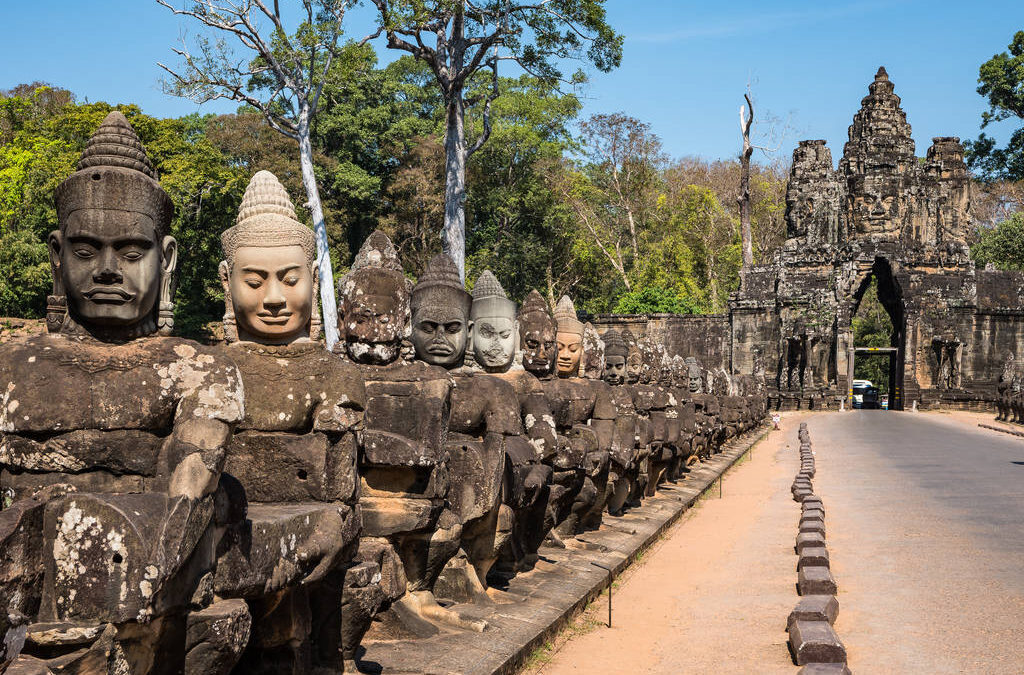
Angkor Thom has five monumental gates. Each gate is topped with large stone faces, and the approach to the gates includes rows of figures holding a naga, or serpent.
The South Gate is the most famous because many visitors enter Angkor Thom that way.
It is also one of the best photo spots in the whole Angkor area.
Angkor Wat has a grand entrance too, but it does not have the same fortified city gate system as Angkor Thom. Angkor Wat’s entrance is more about temple procession and sacred approach. Angkor Thom’s gates are about entering a royal city.
Bayon Is Inside Angkor Thom
This is one of the biggest points people mix up.
Bayon is not Angkor Thom itself.
Bayon is a temple inside Angkor Thom.
It sits at the centre of the walled city and is one of the most famous temples in the Angkor area. When people say they visited Angkor Thom and saw the faces, they usually mean they visited Bayon.
So the relationship works like this.
- Angkor Thom is the walled city.
- Bayon is the central temple inside Angkor Thom.
- Angkor Wat is a separate temple complex nearby.
That clears up a lot of confusion fast.
Artistic Differences
Angkor Wat and Angkor Thom also feel different artistically.
Angkor Wat’s art is grand, ordered, and deeply tied to Hindu stories. Its bas-reliefs are long, detailed, and full of gods, armies, kings, heavens, and mythic scenes.
Angkor Thom, especially Bayon, feels more human and strange.
Bayon has religious carvings, but it also shows scenes of everyday life. You can see markets, battles, boats, animals, workers, soldiers, and ordinary people.
That makes Bayon feel less distant than Angkor Wat in some ways.
Angkor Wat can feel like a sacred mountain.
Bayon can feel like a stone city full of faces and stories.
Both are incredible, but they create very different moods.
Size Differences
Angkor Wat is huge for a temple complex.
Angkor Thom is huge because it is a city.
Angkor Thom covers a much larger area, about 9 square kilometres inside its walls. The walls run about 3 kilometres on each side, with a moat around them.
Angkor Wat is more compact by comparison, but it is still one of the largest religious monuments in the world.
This is why comparing their size can be tricky.
Angkor Thom is larger as a site because it is a walled city.
Angkor Wat is more massive as one temple complex.
So if your feet hurt more after Angkor Thom, that is not your imagination. The place is spread out.
Visitor Experience
Angkor Wat feels like one grand visit.
You usually enter by the main causeway, walk toward the towers, explore the galleries, climb into the upper levels if open, and move through the central temple area.
It has a strong beginning, middle, and centre.
Angkor Thom feels more like visiting several places inside one ancient city.
You might enter through the South Gate, stop at Bayon, walk to Baphuon, see the Terrace of the Elephants, visit the Terrace of the Leper King, and look around the Royal Palace area.
It is less like one building and more like a route.
Both are worth seeing, but they require different energy.
Angkor Wat rewards slow temple viewing.
Angkor Thom rewards moving from stop to stop and noticing how the city fits together.
Which Is Better to Visit?
You should visit both if you can.
Angkor Wat is the must-see icon. It is the most famous temple, the best sunrise spot, and the site many visitors dream about before they arrive.
Angkor Thom gives you a stronger feeling of the Khmer Empire as a city and political centre. Bayon alone makes it worth the visit, but the gates, terraces, and surrounding ruins add much more.
If you only have one day at Angkor, most routes include both Angkor Wat and Angkor Thom.
That is the smart choice.
Skipping Angkor Wat would be like going to Paris and skipping the Eiffel Tower. Skipping Angkor Thom would be like going to Paris and ignoring the whole city around it. Bit dramatic, but you get the idea.
Can You Visit Angkor Wat and Angkor Thom in One Day?
Yes, you can visit both in one day.
A common route is Angkor Wat for sunrise, then Angkor Thom after breakfast or later in the morning. Inside Angkor Thom, most visitors focus on Bayon, Baphuon, the Terrace of the Elephants, and the Terrace of the Leper King.
That said, one day can feel rushed.
If you want to see both properly, take your time. Angkor Wat has long galleries and upper levels, while Angkor Thom includes several separate stops.
For a smoother day, start early, bring water, wear comfortable shoes, and do not try to sprint through everything like you are in a temple-themed obstacle course.
What Should You See First?
If it is your first time, see Angkor Wat first.
It gives you the classic Angkor experience and helps you understand why the site is so famous. The scale, symmetry, carvings, and towers set the scene.
After that, visit Angkor Thom.
Entering through the South Gate and then arriving at Bayon gives you a completely different feeling. Angkor Wat feels grand and balanced. Bayon feels mysterious and alive.
Seeing them in that order helps the contrast stand out.
Common Mistakes Visitors Make
- Thinking Angkor Thom and Angkor Wat are the same site.
- Calling Bayon Angkor Thom instead of understanding Bayon is inside Angkor Thom.
- Only visiting Angkor Wat and missing Angkor Thom.
- Trying to rush both sites in the hottest part of the day.
- Not bringing enough water or sun protection.
- Expecting Angkor Thom to be one temple rather than a city route.
The good news is that once you know the difference, planning becomes much easier.
Angkor Thom Compared With Angkor Wat in Simple Terms
Use this if you want the easiest possible memory trick.
- Angkor Wat is the famous temple with five towers.
- Angkor Thom is the walled city with Bayon inside it.
- Angkor Wat came earlier.
- Angkor Thom came later.
- Angkor Wat began as Hindu.
- Angkor Thom was mainly Buddhist.
- Angkor Wat is best for sunrise and grand temple design.
- Angkor Thom is best for gates, faces, terraces, and city layout.
Why the Difference Matters
Knowing the difference between Angkor Wat and Angkor Thom helps you understand Angkor properly.
You stop seeing the site as a random group of ruins and start seeing different chapters of Khmer history.
Angkor Wat shows the royal Hindu vision of Suryavarman II.
Angkor Thom shows the Buddhist city vision of Jayavarman VII.
One is a temple built to represent sacred order.
The other is a capital city built after war, recovery, and religious change.
That makes visiting both much more meaningful.
Final Thoughts
Angkor Wat and Angkor Thom are both major Khmer sites, but they are not interchangeable.
Angkor Wat is a single temple complex built earlier under Suryavarman II and first dedicated to Vishnu. Angkor Thom is a later walled city built under Jayavarman VII, with Bayon at its centre.
Angkor Wat gives you the great temple-mountain experience.
Angkor Thom gives you the royal city experience.
See both, and you get a much better picture of Angkor’s power, religion, art, and history.
Plus, you’ll finally stop mixing up the names. Small win, but a very useful one when your driver asks where you want to go next.