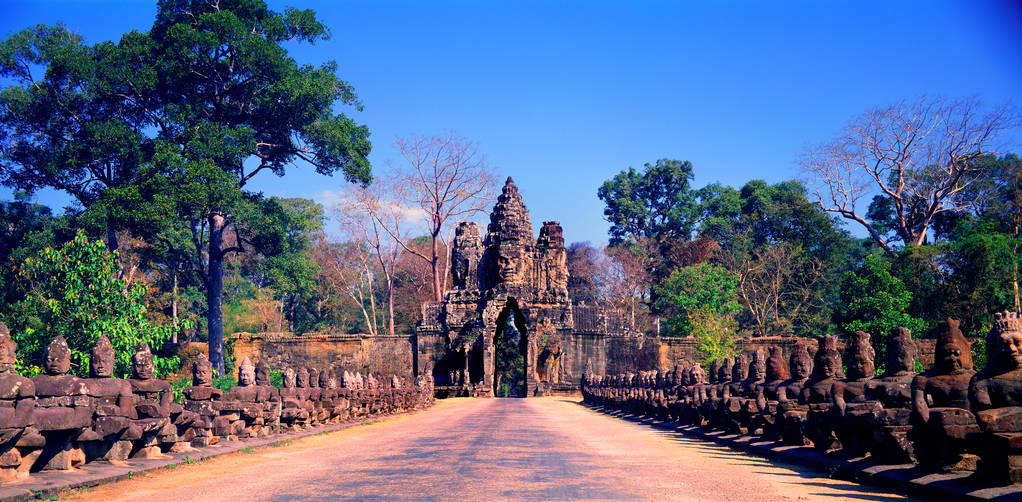
The South Gate of Angkor Thom is one of the most powerful entrances in the whole Angkor area.
It is not just a nice stone gateway for photos.
It marks the entrance into Angkor Thom, the great walled city built under King Jayavarman VII in the late 12th century. It also blends royal power, Buddhist meaning, Hindu mythology, city defence, and Khmer architecture into one dramatic approach.
That is why it feels so memorable.
Before you even reach Bayon, before you see the royal terraces, before you properly enter the old city, the South Gate already tells you what Angkor Thom was meant to be.
A sacred city.
A royal capital.
A protected world.
And yes, also one of the best photo spots in Cambodia. Sometimes history knows how to pose.
Quick Answer
The South Gate is significant because it was the main southern entrance into Angkor Thom, Jayavarman VII’s great royal city. Its giant stone faces, causeway of gods and demons, naga balustrades, moat, walls, and Buddhist royal symbolism marked the movement from the ordinary world into a sacred city centred on Bayon Temple.
Key Takeaways
- The South Gate is one of the five gates of Angkor Thom.
- It is the most common entrance for visitors coming from Angkor Wat.
- Angkor Thom was built as the great royal city of King Jayavarman VII.
- The gate is part of a fortified city wall surrounded by a moat.
- The causeway is lined with gods and demons holding a naga serpent.
- This scene refers to the Churning of the Ocean of Milk.
- The giant faces on the gate are debated, but they are often linked with Avalokiteshvara, Jayavarman VII, or guardian symbolism.
- The gate represents protection, royal authority, Buddhist compassion, and the journey into sacred space.
- It is one of the best places to understand Angkor Thom before visiting Bayon.
The South Gate at a Glance
| Feature | What You See | Why It Matters |
|---|---|---|
| Main role | Southern entrance into Angkor Thom | It marks the start of the royal city experience |
| Main builder | King Jayavarman VII | It reflects his Buddhist royal vision |
| Famous feature | Giant stone faces | They suggest protection, compassion, and royal authority |
| Causeway scene | Gods and demons pulling a naga | It refers to the Churning of the Ocean of Milk |
| City setting | Moat, wall, gate, road, and Bayon beyond | It connects defence with sacred city planning |
| Visitor value | Strong first view of Angkor Thom | It helps you understand the city before reaching Bayon |
What Is the South Gate of Angkor Thom?
The South Gate is the southern entrance into Angkor Thom.
Angkor Thom means Great City, which is a pretty honest name. It was one of the last great capitals of the Khmer Empire and is strongly linked with King Jayavarman VII.
The city was built as a large square enclosure with high walls, a surrounding moat, and five gates. There is one gate at each main direction, plus an extra Victory Gate on the east side.
The South Gate is the one most visitors use because it sits on the route from Angkor Wat into Angkor Thom.
That makes it the classic first entrance into the ancient city.
You cross the causeway, pass between the rows of stone figures, move under the giant faces, and then continue toward Bayon at the centre of the city.
It is a proper entrance.
Not just a doorway.
Why Is the South Gate So Famous?
The South Gate is famous because it gives you one of the most complete and dramatic views of Angkor Thom.
You get the moat.
You get the causeway.
You get the rows of gods and demons.
You get the naga serpent.
You get the giant face tower above the gate.
That is a lot happening before you have even reached Bayon.
It is also one of the best restored and easiest to access gates, which is why so many visitors stop there for photos.
But the gate is not famous only because it looks good.
It is famous because it works as a visual summary of Angkor Thom’s meaning. It brings together mythology, Buddhism, kingship, city planning, and Khmer stonework in one powerful scene.
It Marked the Entrance Into a Sacred City
The South Gate mattered because it marked a change in space.
Outside the gate was the wider world.
Inside the gate was Angkor Thom, the royal city.
That shift was not only practical. It was symbolic.
The road through the gate leads toward Bayon, the temple at the centre of Angkor Thom. Bayon was linked with Jayavarman VII’s Buddhist state vision and sat at the heart of the city layout.
So when people entered through the South Gate, they were not just entering a city.
They were entering a planned sacred space.
The moat, bridge, figures, faces, and road all helped make that movement feel meaningful.
Ancient Khmer architects really understood the power of a good entrance.
The Giant Faces on the South Gate
The most famous feature of the South Gate is the face tower.
Large calm faces look out in different directions from the top of the gate. They are similar to the faces at Bayon, which gives the South Gate a direct visual link to the central temple of Angkor Thom.
But here is where you need to be careful.
The faces are often described as Avalokiteshvara, the bodhisattva of compassion in Mahayana Buddhism. That interpretation makes sense because Jayavarman VII was a Buddhist king and Bayon was part of his Buddhist royal city.
But scholars still debate the exact meaning.
The faces may represent Avalokiteshvara. They may reflect Jayavarman VII himself in a semi-divine form. They may suggest guardian figures watching over the city. They may also combine more than one idea at once.
That last option feels very Angkor.
One face.
Several meanings.
Why the Faces Matter
The faces matter because they give the gate a feeling of watchfulness and protection.
They are calm, not angry. They do not look like they are shouting at you to leave. They look steady, powerful, and almost too peaceful for their size.
That calm expression fits the Buddhist feeling of compassion and spiritual authority.
At the same time, the huge scale fits royal power. The king’s city is not entered through a small plain gate. It is entered under giant faces looking across the land.
That sends a message.
The city is protected.
The ruler is powerful.
The sacred centre is watching.
Not creepy exactly.
But you do feel seen.
The Causeway Shows the Churning of the Ocean of Milk
The causeway leading to the South Gate is one of its most meaningful features.
On both sides, stone figures hold a long naga serpent. One side represents gods, often called devas. The other side represents demons, often called asuras.
Together, they refer to the Hindu myth called the Churning of the Ocean of Milk.
In that story, gods and demons work together to churn the cosmic ocean and produce amrita, the nectar of immortality. They use the serpent Vasuki as the rope and Mount Mandara as the churning rod.
At Angkor Thom, the gate and city layout turn that myth into architecture.
You do not just read the story.
You walk through it.
Why Gods and Demons Line the Entrance
The gods and demons are not just there to look dramatic.
They show cosmic struggle and balance.
In the myth, both sides are needed to churn the ocean. That does not mean the demons are suddenly the good guys. It means the universe is full of tension, force, struggle, and cooperation.
At the South Gate, this scene creates a powerful entrance.
Before entering the royal city, you pass between opposing forces pulling the naga serpent. The old human world is behind you. The sacred city is ahead.
That is strong storytelling.
No signboard needed.
The Naga Serpent and the Moat
The naga serpent is another key part of the South Gate’s meaning.
Nagas are powerful serpent beings in South and Southeast Asian religion and art. In Khmer temple design, they often mark sacred routes, protect entrances, and connect water, fertility, and divine power.
At the South Gate, the naga is held by the gods and demons along the causeway.
The causeway crosses the moat, which adds even more meaning. You are crossing water, moving from outside to inside, and following a route guarded by mythic beings.
That makes the entrance feel like a ritual journey.
It is not just “walk across the bridge and turn left.”
It is “cross from the ordinary world into the royal sacred city.”
Much better, really.
The Gate Was Also Practical
The South Gate was symbolic, but it was also practical.
Angkor Thom was a fortified city. Its walls were built of laterite and surrounded by a moat. Gates controlled entry into the city and helped protect the royal centre.
That matters because Angkor Thom was built after a period of serious conflict, including the Cham attack on Angkor in the late 12th century.
Jayavarman VII did not build an open, casual city.
He built a protected royal capital.
The South Gate helped control movement, mark authority, and protect the city while also making the entrance feel sacred and impressive.
That mix is classic Khmer planning.
Useful and symbolic at the same time.
How the South Gate Connects to Bayon
The South Gate points you toward Bayon.
That is one of its biggest roles.
After passing through the gate, the road leads north toward the centre of Angkor Thom, where Bayon stands. Bayon was Jayavarman VII’s great state temple and one of the most important Buddhist monuments at Angkor.
The faces on the South Gate prepare you for the face towers at Bayon.
So the gate is not separate from the city experience.
It is the opening chapter.
Bayon is the central scene.
The South Gate tells you what kind of city you are entering before you get there.
Why the South Gate Was Important to Jayavarman VII
Jayavarman VII ruled after a difficult period in Khmer history.
He is often remembered as one of the great builders of Angkor. His projects included Angkor Thom, Bayon, roads, hospitals, rest houses, and major religious structures.
The South Gate fits his wider vision.
It presents a city that is strong, sacred, and Buddhist in feeling. It also shows a ruler who wanted to connect royal authority with compassion, protection, and cosmic order.
That is why the gate feels so serious.
It is not just an entrance to a city.
It is part of a royal message carved in stone.
Architectural Features of the South Gate
The South Gate is impressive because of how many design elements work together.
You have the causeway, the moat, the naga balustrades, the rows of gods and demons, the laterite city wall, the large gate opening, and the face tower above.
Look closely and you may notice:
- Large faces looking in different directions.
- Rows of figures gripping the naga serpent.
- Tri-headed elephant imagery near the gate.
- Devata figures and decorative carving.
- A tall central tower above the entrance.
- Side spaces linked with guard or passage functions.
The design is not random decoration piled onto a wall.
Each part helps build the meaning of the entrance.
What the Tri-Headed Elephant Means
At the gate, you can also see imagery connected with Indra and the three-headed elephant Airavata.
This is another sign of how layered Khmer art can be.
Indra is an important deity in Indian religion, often linked with kingship, storms, and heaven. Airavata, his elephant, appears in Khmer art as a powerful divine mount.
At the South Gate, this imagery adds another layer of protection and divine authority.
So yes, the gate has Buddhist faces, a Hindu myth on the causeway, naga symbolism, and Indra imagery.
Angkor Thom does not do simple.
Is the South Gate Hindu or Buddhist?
The South Gate is best understood as part of Jayavarman VII’s Buddhist royal city.
But it also uses Hindu myths and older Khmer religious symbols.
That might sound confusing, but it is normal for Angkor.
Khmer religion often mixed Hindu and Buddhist ideas across time. A Buddhist king could still use Hindu cosmic stories, naga symbolism, Indra imagery, and sacred mountain ideas.
The South Gate shows that blend clearly.
The face tower points toward the Buddhist world of Jayavarman VII and Bayon.
The causeway points back to Hindu cosmology through the Churning of the Ocean of Milk.
Together, they create a gateway that feels both Buddhist and cosmological.
That is part of its power.
Why the South Gate Is the Best Entrance for Visitors
The South Gate is usually the best entrance for first-time visitors because it gives the strongest arrival experience.
Most routes from Angkor Wat enter Angkor Thom through this gate, so it naturally fits a temple day plan.
It is also one of the most photogenic entrances in the Angkor area.
You get a straight view down the causeway toward the gate. The rows of figures create strong lines. The giant faces rise above the entrance. The moat adds reflection and atmosphere.
It is very hard to take a boring photo there.
Although somehow, with enough bad lighting and a thumb over the lens, anything is possible.
What to Look For When You Visit
Do not rush through the South Gate.
Most people stop for a quick photo and then move on to Bayon, but the gate deserves a few minutes of attention.
Look for:
- The difference between the gods and demons on the causeway.
- The long naga serpent held by the figures.
- The calm giant faces above the gate.
- The moat on both sides of the causeway.
- The road alignment leading toward Bayon.
- The elephant and divine imagery near the gate.
- Restored sections beside older original stone.
Once you notice those details, the South Gate becomes much more than a photo stop.
It becomes a lesson in how Khmer builders used architecture to tell a story.
How to Read the South Gate in Simple Terms
| Part of the Gate | Simple Meaning | Deeper Meaning |
|---|---|---|
| Moat | Water around the city | A boundary between ordinary and sacred space |
| Causeway | Road into Angkor Thom | A ceremonial path into the royal city |
| Gods and demons | Rows of stone figures | The cosmic struggle from the Churning of the Ocean of Milk |
| Naga serpent | Long stone serpent held by figures | Protection, water, power, and sacred passage |
| Giant faces | Large calm faces on the tower | Compassion, royal authority, guardianship, or a blend of meanings |
| Road to Bayon | Main route into the city | Movement toward the sacred centre of Angkor Thom |
Common Myths About the South Gate
Myth One The Faces Are Definitely Avalokiteshvara
Not definitely.
Avalokiteshvara is one major interpretation, but scholars also connect the faces with Jayavarman VII, guardian symbolism, or a mix of meanings.
Myth Two The Causeway Figures Are Just Decorative
No.
The figures refer to the Churning of the Ocean of Milk, a major Hindu myth about gods, demons, cosmic struggle, and the search for immortality.
Myth Three The South Gate Is Bayon
No again.
The South Gate is an entrance into Angkor Thom. Bayon is the central temple inside the city.
Myth Four Angkor Thom Only Has Four Gates
It would make sense for a square city to have four gates, but Angkor Thom has five.
There is one gate at each main direction and an extra Victory Gate on the east side.
Myth Five The South Gate Was Only for Defence
No.
It had a defensive role, but it was also ceremonial, religious, symbolic, and royal.
How the South Gate Fits Into an Angkor Route
The South Gate usually fits naturally after Angkor Wat.
A common route looks like this:
- Angkor Wat for sunrise or early morning.
- South Gate of Angkor Thom.
- Bayon Temple.
- Baphuon.
- Terrace of the Elephants.
- Terrace of the Leper King.
- Ta Prohm later in the day.
If you are short on time, at least stop at the South Gate before Bayon.
It only takes a few minutes, but it changes how you understand Angkor Thom.
You are not just entering another temple stop.
You are entering the last great royal city of the Khmer Empire.
Best Time to Visit the South Gate
Early morning is usually best.
The light can be softer, the heat is easier, and the area may be less crowded before the main flow of visitors arrives. Late afternoon can also be good for photos, depending on your route and the light.
Midday is less ideal because the sun can be harsh and the stone gets bright.
Also, standing on a road in Cambodian midday heat while trying to photograph ancient gods and demons is a very specific kind of character test.
Bring water.
Visitor Tips for the South Gate
- Ask your driver to stop before entering the gate.
- Walk part of the causeway if traffic and safety allow.
- Look at both sides of the causeway, not just the gate tower.
- Do not climb on the statues or touch fragile carvings.
- Watch for vehicles because the gate is still used as a road entrance.
- Visit early if you want cleaner photos.
- Continue straight to Bayon after passing through the gate.
One practical point matters a lot.
The South Gate is beautiful, but it is also a working route for cars, tuk-tuks, bicycles, and tour vehicles.
Take photos carefully.
Ancient stone is impressive. Getting flattened by a tour bus is less impressive.
Why the South Gate Still Matters Today
The South Gate still matters because it helps visitors understand Angkor Thom before they reach the temples inside.
It shows that the city was not random.
It was planned.
It was defended.
It was sacred.
It was royal.
The gate also shows how Khmer builders could combine several meanings in one structure. It is a doorway, a defensive point, a mythological scene, a Buddhist royal symbol, and a ceremonial route all at once.
That is why the South Gate is so much more than the place where your tuk-tuk slows down for photos.
It is the start of Angkor Thom’s story.
Final Thoughts
The South Gate is significant because it is one of the clearest introductions to Angkor Thom’s power and meaning.
It marks the move into Jayavarman VII’s royal city. It connects the visitor to Bayon at the centre. It uses the Churning of the Ocean of Milk to turn the causeway into a cosmic scene. It uses giant faces to suggest protection, compassion, and royal authority.
It also proves how clever Khmer architecture could be.
Nothing here is only one thing.
The bridge is a story.
The gate is a guard.
The faces are a mystery.
The road is a sacred path.
So when you pass through the South Gate of Angkor Thom, do not treat it as just a quick stop before Bayon.
Slow down.
Look up.
You are walking through one of the greatest entrances the Khmer Empire ever built.