
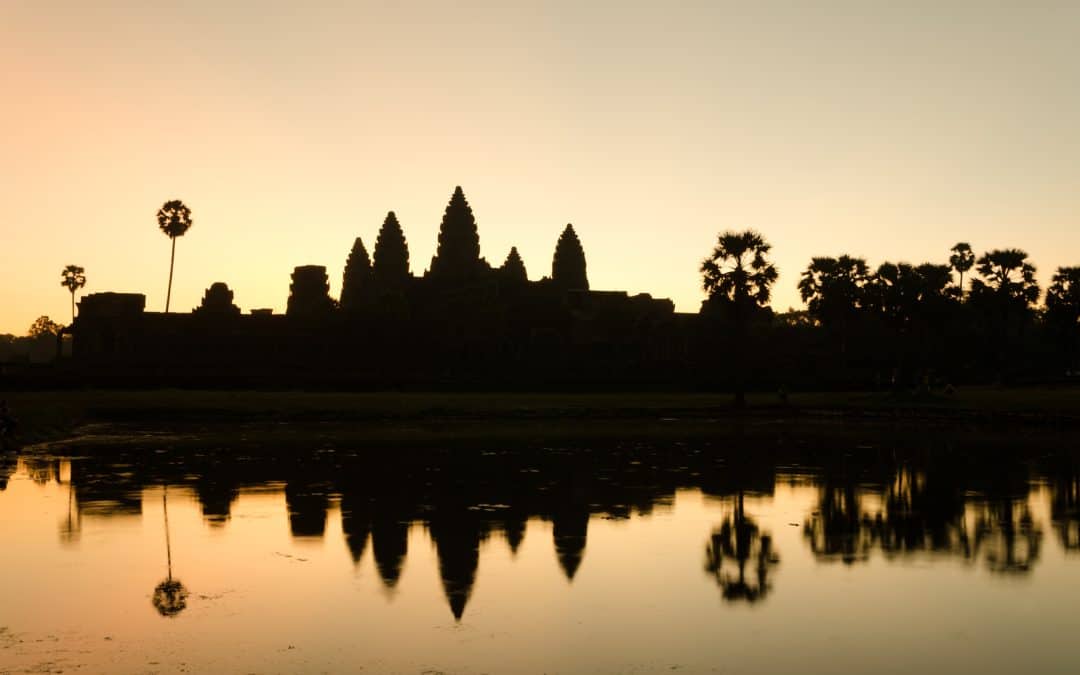
Angkor Wat took around 30 years to build.
That is the simple answer.
Most reliable sources place its main construction in the first half of the 12th century, during the reign of King Suryavarman II. A common estimate is roughly 1116 to 1150, though some official summaries use the wider range of 1113 to 1150.
So if you are wondering whether Angkor Wat took centuries to build, no.
It took decades.
Still, that is wild when you think about the size of the place. Angkor Wat covers hundreds of acres, uses huge amounts of stone, contains long galleries, towers, carvings, courtyards, causeways, and a giant moat.
Building that in about three decades without modern machines is the kind of thing that makes you stare at the walls and quietly respect everyone involved.
Quick Answer
Angkor Wat took about 30 years to build, with the main construction likely running from around 1116 to 1150 during the reign of King Suryavarman II. Some work may have continued after the king’s death, and parts of the decoration were likely never fully completed.
Key Takeaways
- Angkor Wat was built in the 12th century.
- The main construction took around 30 years.
- The temple was built under King Suryavarman II.
- Many sources place the likely building period around 1116 to 1150.
- APSARA lists Angkor Wat as built between 1113 and 1150.
- Angkor Wat was originally dedicated to Vishnu.
- The temple may not have been completely finished before Suryavarman II died.
- The project needed huge numbers of workers, stonecutters, carvers, planners, and support staff.
- It did not take centuries, but it was still one of the greatest building projects in Southeast Asia.
Angkor Wat Construction Timeline at a Glance
| Period | What Happened | What It Means |
|---|---|---|
| 1113 | Suryavarman II became king | This marks the start of the reign linked with Angkor Wat |
| Around 1116 | Construction likely began | Many historians place the start a few years into his reign |
| 1120s and 1130s | Main building work continued | Stone transport, structure, galleries, towers, and carving work likely overlapped |
| Around 1150 | Suryavarman II died | The temple was likely still not fully finished at this point |
| After 1150 | Some finishing or later use continued | The temple’s story did not stop with the king’s death |
The Shortest Honest Answer
The best short answer is this.
Angkor Wat took about 30 years to build.
If you want a slightly wider answer, say around 30 to 37 years, depending on whether you count from Suryavarman II’s coronation in 1113 or from the likely start of construction around 1116.
That difference matters because ancient building dates are not always as neat as modern project dates.
There was no official construction sign saying “Opening soon, 1150.”
Historians have to work from inscriptions, style, royal dates, architectural evidence, and later records. That means the exact start and end dates are estimates, not a clean calendar entry.
Why Do Some Sources Say 30 Years?
The 30 year estimate comes from the likely main building period.
Angkor Wat was probably started a few years after Suryavarman II became king in 1113. Many scholars place the start around 1116. The king died around 1150, and the temple was likely still unfinished when he died.
That gives you a construction period of a little over 30 years.
This is why “about 30 years” is the safest simple answer for readers.
It is clear.
It is easy to remember.
And it avoids making the timeline sound more exact than it really is.
Why Do Some Sources Say 1113 to 1150?
Some sources use 1113 to 1150 because those dates match the reign of Suryavarman II.
He was the king responsible for Angkor Wat, so it makes sense to place the temple within his rule. If you count the whole span of his reign, you get around 37 years.
But that does not prove workers started building Angkor Wat the exact day he became king.
Large royal projects usually took planning before the first major stones were placed. Architects, priests, officials, quarry workers, transport teams, and labour organisers all had to be involved.
So the cleaner way to explain it is this.
Angkor Wat was built during Suryavarman II’s reign, with the main construction probably taking just over 30 years.
Was Angkor Wat Finished Before Suryavarman II Died?
Probably not fully.
Many historians believe Angkor Wat was not completely finished before Suryavarman II died around 1150. Some carving, decoration, or final work may have been left incomplete.
This is not unusual for ancient royal temples.
When a king died, big projects could slow down, change purpose, or lose the intense support they had during his life. Angkor Wat still became one of the greatest Khmer monuments ever built, but that does not mean every planned detail was finished perfectly.
Honestly, that makes it more interesting.
Even one of the world’s greatest temples may have had an ancient version of “we’ll finish that bit later.”
Did Angkor Wat Really Take Centuries to Build?
No, Angkor Wat itself did not take centuries to build.
The wider Angkor region developed across many centuries, with different kings building different temples, cities, reservoirs, roads, and sacred sites. That is probably where the confusion comes from.
Angkor as a whole was a long-running royal and religious landscape.
Angkor Wat was one major project inside that larger world.
So the whole Angkor civilisation developed over centuries, but Angkor Wat’s main construction took around three decades.
That is the difference.
Who Built Angkor Wat?
Angkor Wat was built under King Suryavarman II.
He ruled the Khmer Empire in the first half of the 12th century and is remembered as one of its great temple-building kings. Angkor Wat was his grandest project.
The temple was originally built as a Hindu temple dedicated to Vishnu. It also served as a royal state temple and may have had a funerary role connected to the king’s death and afterlife.
But the king did not build it with his own hands, of course.
The work would have involved planners, priests, architects, engineers, stone workers, sculptors, carvers, transport workers, labourers, cooks, animal handlers, and many people whose names were never written down.
That is the strange thing about Angkor Wat.
We know the king.
We do not know most of the people who made the stones rise.
How Many People Built Angkor Wat?
No one knows the exact number.
One often repeated estimate suggests that hundreds of thousands of people may have been involved across the full project. That does not mean all of them were carving stone at the same time.
A huge temple project needs many kinds of work.
- Quarrying stone.
- Moving stone blocks.
- Preparing foundations.
- Building walls and galleries.
- Carving bas-reliefs.
- Planning religious layout.
- Managing food and supplies.
- Maintaining roads, canals, and work areas.
- Supporting workers day after day.
So when you think about the building time, do not only picture a few workers stacking blocks.
Picture a whole state project.
Angkor Wat was a machine made of people, stone, belief, planning, and royal power.
Why Did It Take So Long?
Angkor Wat took decades because the project was enormous and highly detailed.
This was not only a building.
It was a temple mountain, a royal monument, a sacred map of the universe, and a carved religious storybook all in one.
The builders had to create:
- A huge surrounding moat.
- A long causeway.
- Outer walls and entrance structures.
- Three main gallery levels.
- Five central towers.
- Libraries and smaller structures.
- Long carved bas-reliefs.
- Thousands of decorative figures.
- Stone steps, courtyards, doorways, and lintels.
That is a lot of work before you even start thinking about transport, food, weather, religious rules, and royal expectations.
Basically, it was not a weekend project with a few enthusiastic cousins and a borrowed ladder.
Building With Stone Took Time
Angkor Wat was built mainly with sandstone and laterite.
Sandstone was used for many visible areas because it could be shaped and carved. Laterite was often used for structural parts where appearance mattered less.
The stone had to be quarried, moved, shaped, fitted, lifted, and carved.
Each stage took time.
Even after a wall or gallery was built, artists could spend years carving the surface. Some parts of Angkor Wat are covered with detailed religious scenes from the Ramayana, Mahabharata, and other Hindu stories.
You can build a plain wall fairly fast.
You cannot quickly carve a giant battle scene with gods, demons, armies, horses, chariots, dancers, and tiny jewellery details.
Stone is not forgiving like that.
How Did They Move the Stone?
The exact transport system is still studied, but water routes, canals, roads, rafts, rollers, sledges, animals, and human labour may all have played roles in moving materials around the Angkor region.
The Khmer were skilled at managing water and land.
That mattered because Angkor Wat was not built beside a small pile of ready-made blocks. Stone had to be brought from quarry areas to the construction site, then prepared and placed.
Moving the material was probably one of the biggest parts of the job.
Before anyone carved a devata or raised a tower, someone had to get the stone there.
Not glamorous.
Very necessary.
The Carvings Made the Project Much Slower
Angkor Wat would have taken less time if it were plain.
But plain was not the plan.
The temple walls include huge carved galleries, divine figures, floral designs, battle scenes, royal images, and Hindu stories. These carvings are one of the main reasons Angkor Wat feels so rich today.
They also explain why the building took so long.
Carving sandstone is slow work. The artist has to plan the design, shape the figures, cut details, control depth, and avoid ruining the stone surface.
One bad hit and the ancient version of “undo” does not exist.
That level of detail takes time, skill, and patience.
What Was Built First?
We do not have a perfect step-by-step building record.
But large temple projects usually began with planning, site preparation, water works, foundations, and major structural parts.
At Angkor Wat, the process likely involved overlapping stages.
While some teams worked on foundations or walls, others may have prepared stone, shaped blocks, carved finished sections, or worked on causeways and galleries.
So it probably did not happen in one neat line.
It was more like a giant organised overlap.
One group builds.
One group carries.
One group carves.
One group repairs problems.
One group gets blamed when something is late.
Some things never change.
Why the Timeline Is Still an Estimate
The timeline is still an estimate because we do not have a modern construction record.
No project manager left behind a spreadsheet.
No builder wrote a daily log saying “today we finished the third gallery and everyone complained about the heat.”
Historians use several kinds of evidence instead.
- Dates from Suryavarman II’s reign.
- Inscriptions linked to the period.
- Architectural style.
- Artistic style.
- Comparisons with nearby temples.
- Signs of unfinished carving or later changes.
That evidence points to a main construction period of about 30 years, but the exact dates are still a little flexible.
How Fast Was Angkor Wat Built Compared With Other Ancient Monuments?
For its size and detail, Angkor Wat was built surprisingly fast.
Around 30 years may sound long, but for a vast stone temple with detailed carvings and a huge sacred layout, it is actually impressive.
| Monument | Rough Building Time | Why the Comparison Helps |
|---|---|---|
| Angkor Wat | About 30 years | Huge temple complex with towers, galleries, moat, and detailed carvings |
| Great Pyramid of Giza | About 20 years by common estimates | Massive stone structure with a very different design and purpose |
| Many European cathedrals | Often many decades or centuries | Large sacred buildings could outlast the people who began them |
The point is not that one monument is better than another.
The point is that Angkor Wat’s timeline shows a very high level of organisation.
Building something that large in about three decades means the Khmer state could control labour, resources, planning, and belief on a huge scale.
Why Did the Khmer Build It So Quickly?
The Khmer were able to build Angkor Wat in about 30 years because the empire had the power to organise people and resources.
The project needed royal authority.
It needed skilled planners.
It needed religious specialists.
It needed access to stone.
It needed food systems to support workers.
It needed transport routes.
It needed discipline over many years.
That kind of project only works when a kingdom has strong central organisation. Angkor Wat was not just proof of artistic skill. It was proof that the Khmer Empire could manage a huge project from idea to stone reality.
Was Angkor Wat Built by Slaves?
It is better to be careful with this question.
We do not have a full worker list or modern labour record. The construction likely involved many types of labour, including skilled workers, temple specialists, state labour, local workers, support staff, and people required to serve the royal project.
Ancient state projects often used labour systems very different from modern paid jobs.
But saying simply “slaves built Angkor Wat” is too neat and not well supported as the full story.
What we can say is safer.
Angkor Wat required a massive organised workforce under royal control.
That included highly skilled people as well as heavy labourers who did the physically brutal work.
Why Was Angkor Wat Worth That Much Effort?
Angkor Wat was worth the effort because it did several jobs at once.
It honoured Vishnu.
It showed the power of Suryavarman II.
It acted as a royal state temple.
It displayed Khmer engineering and carving skill.
It represented Mount Meru and the Hindu universe.
It may also have been linked to the king’s death and memory.
That is why the Khmer put so much time and labour into it.
For them, Angkor Wat was not only a building.
It was a sacred statement about power, religion, kingship, and the universe itself.
Hard to do that with a small shrine and a few candles.
What Was Still Unfinished?
Some parts of Angkor Wat may never have been fully finished.
That does not mean the temple looked like a construction site when people used it. It means some decoration, carving, or planned details may have been incomplete when the main royal building campaign ended.
This is common in large ancient monuments.
The main structure can be usable while artists are still working on details.
A temple can be sacred before every surface is finished.
And if the king dies, the next ruler may not have the same interest in finishing another king’s project.
Ancient politics, basically.
How Long Would Angkor Wat Take to Build Today?
With modern machines, a structure of the same size could be built faster in some ways.
But recreating Angkor Wat properly would still take a long time.
Why?
Because the hard part is not only lifting stone.
The hard part is the carving, accuracy, layout, symbolism, materials, and craft. If you wanted a faithful version with hand-carved sandstone and full detail, it would still be a huge project.
Modern cranes can move blocks faster.
They cannot instantly carve thousands of detailed figures with human feeling.
That is why Angkor Wat still feels different from a modern copy.
It has time built into it.
Common Myths About Angkor Wat’s Building Time
Myth One Angkor Wat Took Centuries to Build
No.
The wider Angkor region grew across centuries, but Angkor Wat itself took around 30 years to build.
Myth Two Angkor Wat Was Finished in Only a Few Years
No again.
The temple was far too large and detailed for that. Its main construction took decades.
Myth Three The Exact Start Date Is Known Perfectly
Not quite.
Most scholars place the likely start around 1116, but some summaries use the wider reign period of 1113 to 1150.
Myth Four The King Built It Alone
Definitely not.
Suryavarman II ordered and sponsored the temple, but the work was done by a huge workforce of planners, builders, transport workers, carvers, and support teams.
Myth Five The Temple Was Fully Finished Before the King Died
Probably not.
Many experts believe Angkor Wat was not completely finished before Suryavarman II died.
What Visitors Can Notice Today
When you visit Angkor Wat, the building time becomes easier to understand.
Look at the long galleries.
Look at the bas-reliefs.
Look at the towers.
Look at the moat and causeway.
Look at how many surfaces are carved.
Then remember that this was done without modern machines.
The temple suddenly feels less like a single building and more like a whole ancient world made by hand.
That is why the 30 year timeline is so impressive.
It was not slow.
It was astonishingly organised.
Final Thoughts
Angkor Wat took about 30 years to build.
The main construction likely began around 1116 and continued until around 1150, during the reign of King Suryavarman II. Some sources use the wider range of 1113 to 1150 because that covers his reign and the official construction period often linked with the temple.
The temple was probably not fully finished before the king died, and some decoration may have remained incomplete.
Still, building Angkor Wat in roughly three decades is a remarkable achievement.
The Khmer builders created a vast stone temple with galleries, towers, carvings, sacred layout, and one of the most powerful designs in world architecture.
So the answer is simple, but the achievement is not.
About 30 years.
And nearly 900 years later, people are still trying to work out how they managed it so well.