
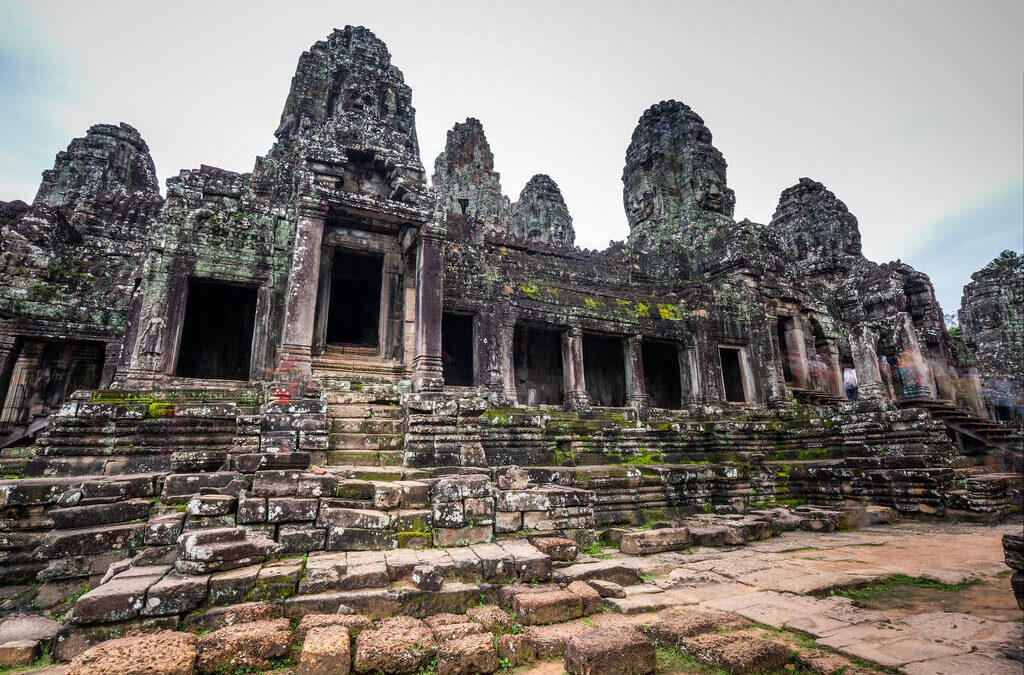
Khmer temple architecture did not appear fully formed at Angkor Wat.
It developed over centuries.
Early builders worked with brick, stucco, and Indian ideas. Later architects used sandstone, giant temple mountains, long galleries, carved towers, sacred layouts, and detailed bas-reliefs. By the time you reach Angkor Wat and Bayon, Khmer architecture had become one of the most recognizable temple styles in the world.
The five key artistic styles that shaped Khmer temple architecture are early brick temple design, temple mountain planning, Banteay Srei decorative carving, classical Angkor Wat style, and Bayon style.
That sounds like a lot, but don’t worry. We’ll keep it clear.
And yes, there will be stone faces. Khmer architecture gets much more fun when the buildings start staring back at you.
Quick Answer
The main artistic styles shaping Khmer temple architecture are early brick and stucco temples, stepped temple mountains, detailed Banteay Srei carving, the grand classical style of Angkor Wat, and the Buddhist Bayon style with face towers and lively bas-reliefs.
Together, these styles show how Khmer builders turned Indian religious ideas, local materials, royal power, and sacred geometry into a temple language of their own.
Key Takeaways
- Khmer temple architecture changed over time rather than staying fixed.
- Early temples often used brick, stucco, laterite, and sandstone details.
- Temple mountain design represented Mount Meru, the sacred mountain in Hindu and Buddhist thought.
- Banteay Srei style is known for small scale and very fine carving.
- Angkor Wat style is known for balance, grand scale, long galleries, and detailed bas-reliefs.
- Bayon style is known for face towers, Buddhist meaning, and scenes of daily life.
- Indian ideas shaped Khmer architecture, but Khmer builders turned them into something local and original.
- Materials mattered because brick, sandstone, and laterite changed what artists could carve and build.
The 5 Key Styles at a Glance
| Style | Main Features | Good Example | Why It Matters |
|---|---|---|---|
| Early brick temple style | Brick towers, stucco decoration, sandstone lintels | Sambor Prei Kuk and Preah Ko | It gave Khmer builders their early temple language |
| Temple mountain style | Stepped pyramids, raised platforms, central shrine | Bakong and Phnom Bakheng | It turned temples into symbolic mountains |
| Banteay Srei style | Small scale, pink sandstone, sharp decorative carving | Banteay Srei | It shows Khmer carving at its most delicate |
| Classical Angkor Wat style | Five towers, galleries, moat, bas-reliefs, symmetry | Angkor Wat | It marks the high point of Khmer temple design |
| Bayon style | Face towers, Buddhist themes, daily life carvings | Bayon at Angkor Thom | It shows a later Buddhist royal vision |
1. Early Brick Temple Style
Early Khmer temples were often built from brick.
That might sound plain, but these buildings were far from basic. Khmer builders used brick for the main structure, then added stucco, sandstone lintels, carved doorways, and decorative details.
You can see this early style at places like Sambor Prei Kuk, Preah Ko, and some of the Roluos temples.
This style helped set up many ideas that stayed with Khmer architecture for centuries.
- The central sanctuary was the sacred core.
- Doorways and lintels carried rich decoration.
- Towers were shaped to feel vertical and sacred.
- Religious images linked the temple to Hindu and Buddhist worship.
The early brick style also shows how Khmer builders learned from Indian art while making their own local version. The shapes, gods, and sacred layouts had Indian roots, but the final look became Khmer.
Think of it like taking a recipe from somewhere else, then slowly changing the spices until it tastes like home.
Why Brick Changed the Art
Brick affected what artists could do.
Brick is useful for building towers, but it is not as good as sandstone for fine carving. That is why early temples often used stucco for decoration and sandstone for important features like lintels, door frames, and statues.
This gave early Khmer temples a different texture from later Angkorian temples.
They feel warmer, smaller, and more compact. You do not get the huge carved galleries of Angkor Wat yet, but you do see the early building blocks of Khmer temple art.
Literally and artistically.
2. Temple Mountain Style
The temple mountain style is one of the biggest ideas in Khmer architecture.
This style turns the temple into a symbolic mountain. The raised levels, steep steps, central tower, and surrounding walls all point to Mount Meru, the sacred mountain at the centre of the universe in Hindu and Buddhist thought.
This was not just decoration.
It was theology in stone.
When you climbed a temple mountain, you were not just going up some steps. You were moving closer to the divine world. The higher you went, the more sacred the space became.
Temples like Bakong, Phnom Bakheng, Pre Rup, and Baphuon all show this style in different ways.
What Makes a Khmer Temple Mountain
A Khmer temple mountain usually includes several clear features.
- A raised platform or stepped pyramid shape.
- A central sanctuary at the highest point.
- Stairways that make the climb feel dramatic.
- Enclosures that separate ordinary space from sacred space.
- Symbolic links to Mount Meru and the cosmic order.
The temple mountain style also helped kings show power.
If the temple represented the centre of the universe, and the king built it, that said a lot about the king’s place in the world. It linked kingship, religion, land, and cosmic order in one very large building.
Subtle? No.
Effective? Absolutely.
3. Banteay Srei Decorative Style
Banteay Srei style is famous for detail.
If Angkor Wat feels grand, Banteay Srei feels like someone carved jewellery into stone.
Banteay Srei was built in the 10th century and is known for its fine pink sandstone carving. The temple is much smaller than Angkor Wat, but its decoration is incredibly sharp and rich.
You will see detailed lintels, pediments, floral patterns, guardian figures, divine beings, and scenes from Hindu stories.
This style proves a simple point.
A temple does not need to be huge to be unforgettable.
Why Banteay Srei Looks So Different
Banteay Srei looks different for a few reasons.
Its reddish sandstone allowed very fine carving. Its smaller scale helped artists pack detail into almost every surface. The carvings are crisp, deep, and full of movement.
That is why Banteay Srei is often called one of the finest examples of Khmer decorative art.
The style is less about massive scale and more about precision.
At Banteay Srei, the artists did not need giant towers to impress you. They just carved every surface so well that you end up standing there wondering how anyone had that much patience.
4. Classical Angkor Wat Style
The classical Angkor Wat style is what many people think of when they picture Khmer architecture.
It is grand, balanced, symmetrical, and heavily symbolic.
Angkor Wat was built in the 12th century under King Suryavarman II. It was originally dedicated to Vishnu and designed as a temple mountain with long galleries, a wide moat, and five central towers.
This style brings together many earlier Khmer ideas and pushes them to a huge scale.
- The moat helps frame the temple as a sacred island.
- The towers represent the peaks of Mount Meru.
- The galleries create a layered journey toward the centre.
- The bas-reliefs tell Hindu stories and royal messages.
- The symmetry gives the whole complex a calm, ordered feeling.
Angkor Wat style is not just big.
It is controlled.
Everything feels measured, aligned, and placed with care. That is part of why the temple still feels powerful today, even before you know what all the symbols mean.
Bas-Reliefs in the Angkor Wat Style
Bas-reliefs are one of the most important parts of Angkor Wat style.
These are carvings where figures stand out from the stone surface without becoming full statues. At Angkor Wat, the bas-reliefs stretch across long galleries and show Hindu stories, royal scenes, battles, heavens, hells, gods, demons, and celestial dancers.
The famous Churning of the Ocean of Milk is one of the best examples.
These carvings did more than make the temple look beautiful. They taught religious stories, supported royal power, and turned stone walls into a visual guide to the sacred universe.
Basically, the walls were doing a lot of work.
5. Bayon Style
Bayon style feels very different from Angkor Wat style.
It is less smooth and more mysterious. Less perfect symmetry, more faces. A lot more faces.
Bayon sits at the centre of Angkor Thom and is linked with King Jayavarman VII, who ruled in the late 12th and early 13th centuries. He was a major Buddhist king, and Bayon reflects his religious and royal vision.
The most famous feature of Bayon style is the face towers.
These towers show large calm faces looking in different directions. They are often linked with Avalokiteshvara, the bodhisattva of compassion, though some scholars also connect them with Jayavarman VII and divine kingship.
Either way, they are hard to forget.
You walk through Bayon and feel like the temple is quietly watching you. Not in a horror movie way. More like an ancient stone security team with very peaceful expressions.
What Makes Bayon Style Unique
Bayon style is not only about the faces.
It also includes detailed bas-reliefs that show both religious themes and everyday life. You can see battles, markets, boats, animals, soldiers, cooks, workers, and ordinary people.
That makes Bayon feel more human than many earlier temples.
Angkor Wat often feels cosmic and royal. Bayon feels cosmic, royal, and oddly personal. You get gods and kings, but you also get people cooking, trading, marching, fighting, and living.
That is one reason Bayon is so special.
It gives you a glimpse of the Khmer world, not just Khmer religion.
How Indian Influence Shaped Khmer Temple Art
Indian influence shaped Khmer temple architecture from the start.
Ideas from Hinduism and Buddhism came into Cambodia through trade, migration, learning, and royal culture. Khmer builders adapted Indian ideas about gods, sacred mountains, mandalas, temple planning, and sculpture.
But Khmer architecture was not a copy of Indian architecture.
That part matters.
Khmer artists took outside ideas and made them local. They built freestanding temple mountains, used regional materials, developed their own carving style, and created temple cities that matched Khmer royal power.
So yes, Indian influence was strong.
But the final result was deeply Khmer.
How Materials Shaped the Styles
Materials played a huge role in Khmer temple art.
You can learn a lot about a temple just by looking at what it is made from.
| Material | How Khmer Builders Used It | How It Affected the Style |
|---|---|---|
| Brick | Used in many early temple towers | Worked well for structure but needed stucco or sandstone for fine detail |
| Stucco | Used to decorate brick surfaces | Allowed early temples to have more ornament |
| Laterite | Used for foundations, walls, and hidden structural parts | Strong but rough, so it was not ideal for fine carving |
| Sandstone | Used for doorways, lintels, walls, towers, and sculpture | Allowed deeper carving and richer surface detail |
| Wood | Used for some buildings and roof parts | Most wood has not survived, which changes how we see Khmer sites today |
The move from brick to more sandstone changed everything.
Sandstone gave artists a better surface for carving. That helped create the long bas-reliefs of Angkor Wat, the fine detail of Banteay Srei, and the face towers of Bayon.
No sandstone, no Angkor look as most people know it.
How Sacred Geometry Guided the Temples
Sacred geometry helped shape many Khmer temples.
That does not mean the builders were just playing with shapes. Geometry helped connect the temple to religion, kingship, astronomy, and the idea of the universe.
Khmer temples often used central axes, cardinal directions, enclosure walls, galleries, moats, and raised levels to create a sacred plan.
At Angkor Wat, the temple layout works like a model of the cosmos. The towers, galleries, moat, and central shrine all help turn the temple into a symbolic universe.
This is why Khmer temples can feel so ordered.
They were not random piles of beautiful stone. They were planned as sacred spaces where every direction, level, and boundary had meaning.
Common Decorative Motifs in Khmer Temple Architecture
Khmer temples use many repeated decorative motifs.
Once you know what to look for, you start spotting them everywhere. It is a bit like learning the temple’s visual language.
- Apsaras and devatas showing celestial female figures.
- Nagas showing serpent figures linked with protection and water.
- Garudas showing bird-like divine beings often linked with Vishnu.
- Kalas showing fierce faces linked with time and protection.
- Lotus forms showing purity, sacred growth, and divine beauty.
- Lintels showing gods, myths, animals, and sacred scenes above doorways.
- Colonettes showing carved vertical supports beside doors and openings.
These details were not just there to fill space.
They gave the temple meaning, guarded entrances, told stories, and made the building feel alive.
Why Khmer Temple Styles Changed Over Time
Khmer temple styles changed because Khmer society changed.
Different kings had different religious goals. Materials improved. Artists gained new skills. Capitals moved. Hindu and Buddhist ideas shifted. Builders learned from older temples and then tried something new.
That is why Khmer architecture has such a strong timeline.
You can move from early brick towers to temple mountains, then to Banteay Srei’s fine carving, then to Angkor Wat’s grand classical style, then to Bayon’s Buddhist face towers.
It is like watching Khmer art grow up in stone.
And honestly, it aged very well.
Which Style Is the Most Famous?
The most famous style is the classical Angkor Wat style.
That is because Angkor Wat is the best-known Khmer temple in the world. It is also the symbol on Cambodia’s national flag and one of the most visited sites in Southeast Asia.
But famous does not always mean most detailed.
Banteay Srei may win for fine carving.
Bayon may win for atmosphere.
Temple mountain style may win for pure sacred drama.
Early brick temples may win for showing where it all began.
Each style matters because each one explains a different step in Khmer architecture.
How to Spot These Styles When Visiting Angkor
If you are visiting the Angkor area, here is a simple way to spot the styles.
- If the temple is brick with sandstone details, think early Khmer or early Angkorian style.
- If it rises like a stepped pyramid, think temple mountain style.
- If the carvings are tiny, sharp, and pinkish sandstone, think Banteay Srei style.
- If you see grand towers, long galleries, and huge Hindu bas-reliefs, think Angkor Wat style.
- If you see giant calm faces and scenes of daily life, think Bayon style.
This makes temple visits much more interesting.
Instead of seeing every ruin as just another old building, you start reading the style. You notice the material, the carving, the layout, and the mood.
That is when Angkor really starts to open up.
Common Myths About Khmer Temple Architecture
Myth One All Khmer Temples Look the Same
No, they really do not.
Some are brick towers. Some are stepped temple mountains. Some are covered in fine carvings. Some are giant state temples. Some are Buddhist city temples with face towers.
Once you learn the styles, the differences become much easier to see.
Myth Two Angkor Wat Was the Beginning of Khmer Architecture
No.
Angkor Wat came after centuries of earlier Khmer building. It is a high point, not the starting point.
Myth Three The Carvings Were Just Decoration
No again.
The carvings told religious stories, showed royal power, marked sacred space, and helped protect entrances. They were beautiful, but they also had a job.
Myth Four Indian Influence Means Khmer Art Was Not Original
Wrong.
Khmer builders used Indian religious and artistic ideas, but they reshaped them into a local style. The result was not a copy. It was Khmer architecture.
Why These Styles Still Matter
These five styles still matter because they help explain how Khmer temple architecture became so powerful.
You can see the growth from simple brick forms to massive sacred landscapes. You can see how builders learned to handle sandstone, carve stories, shape space, and turn royal faith into architecture.
Khmer temples were not only built to stand.
They were built to teach, impress, protect, honour gods, support kings, and represent the universe.
That is a big job for a pile of stone.
Somehow, they pulled it off.
Final Thoughts
The five key artistic styles shaping Khmer temple architecture are early brick temple design, temple mountain planning, Banteay Srei decorative carving, classical Angkor Wat style, and Bayon style.
Each one added something different.
Brick temples gave Khmer architecture its early structure. Temple mountains gave it sacred height. Banteay Srei brought fine carving. Angkor Wat brought balance, scale, and cosmic design. Bayon brought faces, Buddhist meaning, and scenes of daily life.
Together, these styles show why Khmer temples still feel so powerful today.
They are not just old buildings.
They are stone records of faith, kingship, skill, imagination, and a civilisation that knew exactly how to make architecture feel larger than life.