
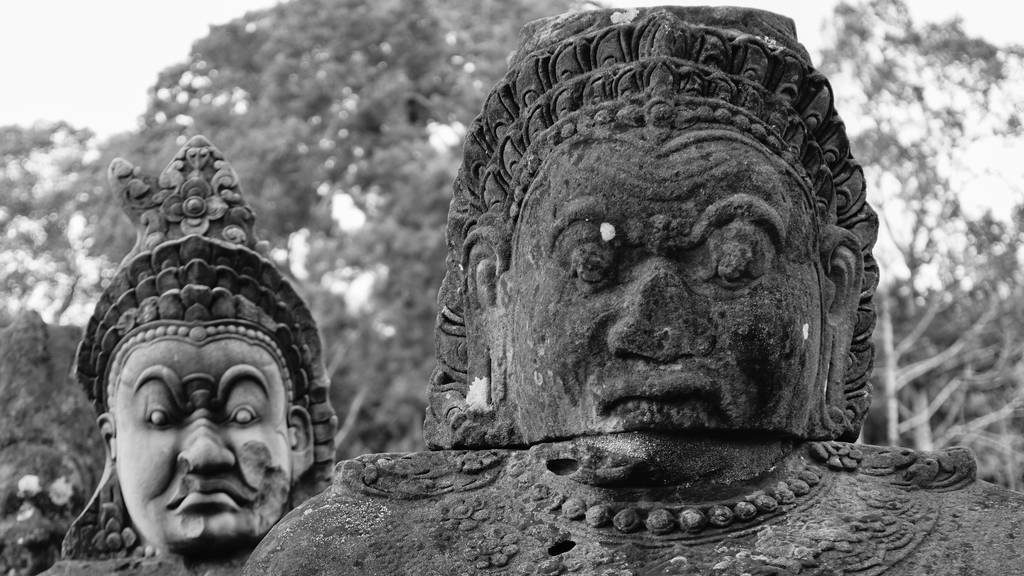
Angkor Wat is not just a temple with beautiful towers.
It is also one of the greatest stone storybooks in the world.
Walk through its galleries and you’ll see Hindu gods, demons, kings, warriors, celestial dancers, sacred animals, and mythic battles carved into sandstone. These scenes were not added as pretty background detail. They helped explain the religious world Angkor Wat was built to honour.
The temple was originally dedicated to Vishnu, one of the main gods in Hinduism. That is why so many of its carvings focus on Vishnu, his avatars, cosmic order, and stories from the great Hindu epics.
Basically, Angkor Wat turns Hindu mythology into architecture.
And it does it on a massive scale.
Key Takeaways
- Angkor Wat was first built as a Hindu temple dedicated to Vishnu.
- The temple’s design reflects Mount Meru, the sacred mountain at the centre of the universe in Hindu belief.
- The walls include scenes from the Ramayana and Mahabharata.
- The Churning of the Ocean of Milk is one of Angkor Wat’s most famous Hindu bas-reliefs.
- Vishnu appears through direct imagery and through avatars such as Rama and Krishna.
- The carvings show gods, demons, celestial dancers, kings, armies, heavens, and hells.
- Apsaras and devatas decorate the temple and connect the human world with the sacred world.
- These carvings were religious stories, royal messages, and teaching tools all at once.
Hindu Stories at Angkor Wat at a Glance
| Story or Symbol | Where It Appears | What It Means |
|---|---|---|
| Vishnu | Across carvings, temple dedication, and sacred design | Protection, balance, and cosmic order |
| Churning of the Ocean of Milk | East gallery | Gods and demons working to create the nectar of immortality |
| Ramayana | West gallery scenes | Rama’s battle against Ravana and the fight to restore order |
| Mahabharata | West gallery scenes | War, duty, family conflict, and moral choice |
| Mount Meru | The whole temple layout | The sacred mountain and home of the gods |
| Apsaras and devatas | Walls, pillars, towers, and galleries | Heavenly beauty, sacred presence, and divine court life |
Angkor Wat Was Built for Vishnu
The main Hindu god linked with Angkor Wat is Vishnu.
King Suryavarman II built Angkor Wat in the 12th century and dedicated it to Vishnu. This was a major choice because many earlier Khmer royal temples were more closely linked with Shiva.
Vishnu is often connected with preserving order in the universe. That made him a powerful god for a king to honour.
A good ruler wanted to be seen as someone who protected the kingdom.
Vishnu protected the universe.
See the match?
For the Khmer Empire, this link between Vishnu and kingship helped turn Angkor Wat into more than a place of worship. It became a royal statement carved in stone.
Why Vishnu Matters So Much at Angkor Wat
Vishnu’s role at Angkor Wat runs deeper than one statue or one carving.
He is tied to the temple’s purpose, layout, stories, and royal meaning. The temple’s west-facing design may also connect with Vishnu, although scholars still debate all the reasons for that unusual orientation.
You can see Vishnu’s presence through:
- The original dedication of the temple.
- The Churning of the Ocean of Milk relief.
- Stories involving Rama and Krishna.
- Images of cosmic order and divine protection.
- The temple’s role as a royal sacred monument.
Angkor Wat was not simply saying Vishnu was worshipped here.
It was saying the king, the temple, and the universe were all tied to sacred order.
Small idea? No chance.
The Churning of the Ocean of Milk
The Churning of the Ocean of Milk is one of the most famous carvings at Angkor Wat.
You’ll find it in the east gallery, where the story stretches across a long sandstone wall. It shows devas, meaning gods, and asuras, meaning demons, pulling the serpent Vasuki like a giant rope.
They are churning the cosmic ocean to produce amrita, the nectar of immortality.
Vishnu stands at the centre of the story.
This scene matters because it shows the universe being brought back into order. The gods and demons pull in opposite directions, yet both sides are part of the cosmic action.
It is dramatic.
It is crowded.
It is full of movement.
And it is carved into stone with a level of detail that makes you wonder how anyone had the patience to finish it.
What to Look For in the Churning Scene
If you stand in front of the Churning of the Ocean of Milk, do not try to understand everything in one second.
Start with the basics.
- Look for the long serpent running across the scene.
- Find the gods on one side and the demons on the other.
- Look for Vishnu near the centre.
- Notice how the figures pull in opposite directions.
- Look above and below the main line for extra figures and movement.
- Step back first, then move closer for detail.
The carving is easier to read when you treat it like a moving story, not a single frozen picture.
It is basically an ancient action scene, but with more theology and fewer explosions.
The Ramayana at Angkor Wat
The Ramayana is one of the great Hindu epics shown at Angkor Wat.
Its main story follows Rama, his wife Sita, his brother Lakshmana, the monkey general Hanuman, and the demon king Ravana.
At Angkor Wat, Ramayana scenes show the fight between Rama and Ravana. The most famous Ramayana relief is the Battle of Lanka in the north section of the west gallery.
This scene is not only about war.
It is about duty, loyalty, love, courage, and the defeat of destructive pride. Rama is understood as an avatar of Vishnu, so his story fits Angkor Wat’s original dedication perfectly.
The temple uses Rama’s story to show the victory of order over chaos.
That is a very Vishnu kind of message.
Rama, Ravana, and Hanuman in Stone
The Ramayana carvings are full of characters, but three figures matter most for many visitors.
| Figure | Role in the Story | Why It Matters at Angkor Wat |
|---|---|---|
| Rama | Hero prince and avatar of Vishnu | Shows righteous rule, duty, and divine order |
| Ravana | Demon king of Lanka | Shows pride, power, and disorder |
| Hanuman | Monkey general and loyal helper | Shows devotion, courage, and clever action |
When you see monkey warriors fighting demon forces, you are probably looking at a Ramayana scene.
That is one of the easiest clues.
Ancient art becomes much less confusing when you know who the monkeys are.
The Mahabharata on the Temple Walls
The Mahabharata is another major Hindu epic shown at Angkor Wat.
This story is huge. Really huge. It deals with family conflict, war, duty, honour, kingship, and moral choice.
At Angkor Wat, Mahabharata scenes appear in the bas-reliefs of the west gallery. These carvings show battles and heroic figures from the epic tradition.
For Khmer viewers, these scenes were more than entertainment.
They showed the weight of duty and the danger of disorder. They also linked the temple to a wider Hindu world of sacred stories, heroes, gods, and kings.
That made the walls feel like a lesson in how power should behave.
Which, for a royal temple, was very much the point.
Krishna and Vishnu’s Avatars
Vishnu often appears through his avatars.
An avatar is a form that Vishnu takes to restore balance when the world is in trouble. Rama and Krishna are two of his best-known avatars.
At Angkor Wat, this idea matters because the temple is built around Vishnu’s role as protector and preserver. Stories of Vishnu’s avatars give that role a human shape.
Rama shows duty and royal order.
Krishna shows divine wisdom, strategy, and power.
Together, these stories helped the Khmer turn cosmic ideas into scenes people could see and remember.
The message was clear.
When the world falls into disorder, divine power acts to restore balance.
Mount Meru and the Home of the Gods
Angkor Wat’s Hindu stories are not only on the walls.
They are built into the whole temple.
The five main towers are usually understood as a symbol of Mount Meru, the sacred mountain at the centre of the universe in Hindu belief. The central tower rises above the others like the highest peak.
The moat around Angkor Wat can be read as the cosmic ocean.
The outer walls and galleries create layers that separate ordinary space from sacred space.
So when you walk toward the centre of Angkor Wat, you are not just entering a building.
You are moving toward a symbolic mountain of the gods.
That is why the temple feels so serious, even if you do not know the symbolism yet.
How the Temple Layout Tells a Hindu Story
The layout of Angkor Wat works like a sacred journey.
You cross water.
You pass through enclosures.
You move along galleries.
You climb toward the centre.
Each step takes you farther from the normal world and closer to the sacred centre.
This design reflects Hindu cosmology, but it also supports royal power. If the temple is a model of the universe, and the king built the temple, then the king is shown as someone connected to cosmic order.
Again, not subtle.
But very effective.
Apsaras and Devatas at Angkor Wat
Angkor Wat is famous for its carved female figures, often called apsaras or devatas.
You’ll see them across walls, towers, pillars, and galleries. They wear detailed jewellery, patterned clothing, and different hairstyles. No two feel exactly the same when you really look.
In Hindu and Khmer sacred art, these celestial figures connect the human world with the heavenly world. They bring beauty, grace, and sacred presence into the temple.
They also show Khmer artistic skill.
The jewellery, fingers, fabric, hair, and facial expressions are carefully carved. These figures are not background filler. They help create the temple’s sacred atmosphere.
Also, after seeing a few hundred of them, you start noticing hairstyle differences like you are judging an ancient fashion show.
Angkor Wat does that to you.
Are They Apsaras or Devatas?
Visitors often call all the female figures at Angkor Wat apsaras.
That is common, but it can be a little too simple.
Many standing female figures on the walls are better described as devatas, or divine female beings. Apsaras are more strongly linked with dancing celestial figures.
In casual travel language, people often use apsara for both.
That is fine for a quick chat.
But if you want to be more accurate, use devatas for the standing temple figures and apsaras for celestial dancers.
Tiny distinction.
Big temple nerd points.
Gods and Demons in Khmer Stone
Many Angkor Wat carvings show gods and demons in conflict.
This is one of the main themes in Hindu mythology. The universe is not shown as calm all the time. It is full of struggle, action, desire, pride, duty, and repair.
That is why battle scenes appear so often.
The fights are not only fights.
They show moral and cosmic forces.
Gods often stand for order, protection, and divine law. Demons often stand for pride, greed, and disorder. But the stories are rarely flat or boring. Some demons are powerful. Some gods need help. Some victories take effort.
That is what makes the carvings worth reading slowly.
Heaven and Hell at Angkor Wat
Angkor Wat also includes scenes of heaven and hell.
These carvings show moral ideas in a very direct way. Good actions lead to reward. Bad actions lead to punishment.
The scenes can feel intense, especially when you notice the detail.
But they had a clear purpose. They helped teach ideas about karma, justice, duty, and the results of human behaviour.
For visitors today, these carvings show that Angkor Wat was not only about gods and kings.
It was also about how people should live.
Stone can be a surprisingly strict teacher.
Why the Hindu Gods Were Carved Into Angkor Wat
The Hindu gods were carved into Angkor Wat because the temple was built to express a religious worldview.
The carvings helped people see stories that might otherwise live only in texts, rituals, or oral telling. They made sacred ideas visible.
They also helped support the king’s authority.
By placing gods, epics, and cosmic scenes across the temple walls, Angkor Wat showed that the Khmer king ruled within a sacred order. The temple connected royal power with divine power.
That made the carvings useful as art, religion, and politics.
All at the same time.
How to Read the Carvings Without Getting Lost
Angkor Wat’s carvings can be overwhelming.
There is a lot happening.
The best way to read them is to slow down and look for the main clues first.
- Look for gods with multiple arms.
- Look for animals linked with gods, such as Garuda or elephants.
- Look for monkey warriors in Ramayana scenes.
- Look for chariots, bows, clubs, and battle lines.
- Look for repeated rows of figures in cosmic scenes.
- Use a guide if you want the full story.
Do not worry if you cannot identify every figure.
Most people cannot.
The point is to notice the flow of the story, the mood of the scene, and the way the carvings support the temple’s sacred meaning.
Best Hindu Carvings to See at Angkor Wat
| Carving or Area | Main Story | Why You Should See It |
|---|---|---|
| Churning of the Ocean of Milk | Gods and demons churn the cosmic ocean | It is one of the most famous Hindu scenes at Angkor Wat |
| Battle of Lanka | Rama fights Ravana | It shows the Ramayana in dramatic stone detail |
| Mahabharata battle scenes | Heroic conflict and moral duty | They connect the temple to one of Hinduism’s great epics |
| Heaven and hell gallery | Judgement, reward, and punishment | It shows religious teaching in a very visual way |
| Devata figures | Divine female beings | They show beauty, sacred presence, and Khmer carving skill |
Why the Carvings Still Matter Today
The Hindu carvings at Angkor Wat still matter because they preserve the temple’s first identity.
Today, Angkor Wat is widely connected with Buddhism and Cambodian national pride. But its original Hindu meaning is still clear in the stone.
The carvings remind us that Angkor Wat began as a Vishnu temple.
They also show how Khmer artists adapted Indian religious stories into a local style. The stories came from a wider Hindu tradition, but the way they were carved, arranged, and used at Angkor Wat is deeply Khmer.
That is why these walls are so valuable.
They do not only show Hindu mythology.
They show Khmer imagination at work.
Common Myths About Hindu Gods at Angkor Wat
Myth One Angkor Wat Was Always Buddhist
No.
Angkor Wat was first built as a Hindu temple dedicated to Vishnu. Its Buddhist role came later.
Myth Two The Carvings Are Just Decoration
No again.
The carvings told religious stories, supported royal power, and helped explain the sacred meaning of the temple.
Myth Three Every Female Figure Is an Apsara
Not exactly.
Many standing female figures are better called devatas. Apsaras are more closely linked with celestial dancing.
Myth Four The Churning Scene Is Just a Battle
No.
It shows gods and demons churning the cosmic ocean to create the nectar of immortality. It is about cosmic order, struggle, and renewal.
Myth Five You Need to Know Every Hindu Story Before Visiting
No.
A little background helps, but you can still enjoy the carvings by looking at movement, scale, faces, animals, and repeated symbols.
Tips for Seeing the Hindu Stories at Angkor Wat
- Visit with a guide if you want the stories explained clearly.
- Start with the Churning of the Ocean of Milk because it is easier to identify.
- Walk slowly through the galleries instead of rushing to the central towers.
- Look at the carvings from a distance first, then move closer.
- Use angled light when possible because shadows make details clearer.
- Do not touch the carvings because sandstone wears down over time.
- Bring water because gallery viewing still involves plenty of walking.
The carvings reward patience.
If you rush, they look like crowded walls.
If you slow down, they become stories.
Final Thoughts
Hindu gods’ tales at Angkor Wat are not hidden in a corner.
They are carved across the temple’s walls, built into its layout, and tied to its original purpose as a Vishnu temple.
The Churning of the Ocean of Milk shows cosmic struggle and renewal. The Ramayana and Mahabharata show duty, war, loyalty, and moral choice. The devatas and apsaras bring sacred beauty into the stone. Mount Meru gives the whole temple its cosmic shape.
That is why Angkor Wat feels so powerful.
It is not only a building.
It is a temple, a story, a map of the universe, and a record of Khmer religious art all at once.
And if you take the time to read its walls, the gods still have plenty to say.