
The Ramayana is not only told in books.
At Angkor Wat, parts of this ancient story are carved into stone.
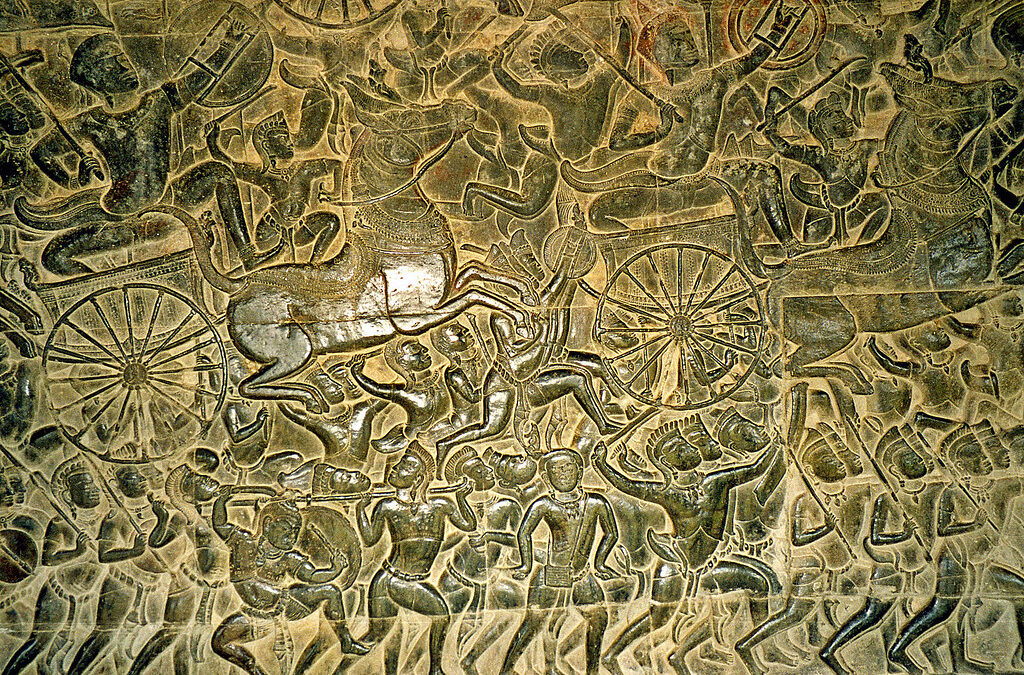
One of the most famous Ramayana scenes at Angkor Wat is the Battle of Lanka, found in the north section of the west gallery. This long sandstone relief shows Rama and his monkey army fighting Ravana and his demon forces in a dramatic final battle.
It is not a small decorative panel you glance at and move on from.
It is a full visual story. Warriors charge. Monkeys fight demons. Ravana appears in his chariot. Rama stands as the hero trying to rescue Sita and defeat evil.
Basically, it is an ancient epic battle scene carved into a temple wall.
And somehow, it still feels alive after more than 800 years.
Quick Answer
The Ramayana appears at Angkor Wat mainly through the Battle of Lanka bas-relief in the north section of the west gallery. This carved scene shows Rama, helped by Hanuman and the monkey army, fighting Ravana’s forces to rescue Sita. The relief matters because it shows how Khmer artists turned a famous Indian epic into a powerful Cambodian temple story connected to Vishnu, kingship, duty, and moral order.
Key Takeaways
- The Ramayana is one of the major Hindu epics shown in Angkor Wat’s bas-reliefs.
- The best-known Ramayana scene at Angkor Wat is the Battle of Lanka.
- This scene is found in the north section of the west gallery.
- The relief shows Rama and his monkey allies fighting Ravana and his demon army.
- Rama is linked with Vishnu, which fits Angkor Wat’s original dedication to Vishnu.
- The Khmer version of the Ramayana became known as the Reamker.
- The carvings were not only decoration. They taught religious, royal, and moral ideas.
- The reliefs show how Indian stories were adapted into Khmer art and temple design.
- Modern conservation helps protect these stone stories from weather, damage, and visitor pressure.
The Ramayana at Angkor Wat at a Glance
| Feature | What It Shows | Why It Matters |
|---|---|---|
| Main Ramayana scene | The Battle of Lanka | It shows the final battle between Rama and Ravana |
| Location at Angkor Wat | North section of the west gallery | It is part of the temple’s major outer gallery reliefs |
| Main hero | Rama | He represents duty, courage, and divine order |
| Main enemy | Ravana | He represents pride, power, and disorder |
| Key helper | Hanuman and the monkey army | They show loyalty, strength, and devotion |
| Khmer connection | The Reamker | It shows how Cambodia adapted the Ramayana into local culture |
What Is the Ramayana?
The Ramayana is one of the great epic stories of South and Southeast Asia.
At its heart, it tells the story of Rama, a prince who must rescue his wife Sita after she is taken by Ravana, the powerful ruler of Lanka.
Rama is helped by his brother Lakshmana, the monkey general Hanuman, and a huge army of monkey warriors. The story includes exile, loyalty, love, war, courage, temptation, and the fight between good and evil.
That is why the Ramayana spread so widely.
It was not just a religious story. It was a story people could use to talk about kingship, duty, marriage, loyalty, justice, and moral behaviour.
In Cambodia, the Ramayana later became known in Khmer tradition as the Reamker.
Same story family.
Local flavour.
Why the Ramayana Appears at Angkor Wat
Angkor Wat was originally built as a Hindu temple dedicated to Vishnu.
That matters because Rama is understood as an avatar of Vishnu. In simple words, Rama is one of the forms Vishnu takes on earth to restore order.
So a Ramayana scene at Angkor Wat is not random.
It fits the temple’s original religious meaning.
Angkor Wat was designed to show sacred order, royal power, and the Hindu universe. The Ramayana helped support those ideas because Rama is the model of a righteous ruler and a loyal warrior.
For Khmer kings, that message would have been powerful.
A king wanted to be seen as strong, just, divinely supported, and able to protect order from chaos. Rama was the perfect hero for that message.
Not bad branding for the 12th century.
Where Are the Ramayana Reliefs at Angkor Wat?
The main Ramayana relief at Angkor Wat is in the north section of the west gallery.
This is the Battle of Lanka scene.
That detail matters because some descriptions loosely say “northern gallery,” which can confuse visitors. The more accurate location for this famous Ramayana battle is the north wing or north section of the western gallery.
The western gallery also includes scenes from the Mahabharata, another great Indian epic. This means one side of Angkor Wat’s outer gallery brings together two huge epic traditions.
If you are walking around the bas-reliefs, take your time here.
The carvings are busy. Very busy.
At first, it may look like a wall full of fighting figures. But once you slow down, the story starts to separate into armies, leaders, animals, weapons, and divine characters.
What Does the Battle of Lanka Show?
The Battle of Lanka shows the final conflict between Rama and Ravana.
Ravana has taken Sita, and Rama has come to fight for her return. He is supported by Hanuman and the monkey army, while Ravana commands his demon warriors.
In the relief, you can look for:
- Rama with his bow.
- Ravana in a chariot.
- Monkey warriors fighting demon soldiers.
- Chaotic battle movement across the stone.
- Layered figures that create a sense of depth.
- Weapons, chariots, bodies, and animal forms.
The scene feels packed because it is meant to feel like war.
This is not a calm royal portrait. It is movement, noise, danger, and drama turned into stone.
And unlike a painting, this relief had to be carved directly into sandstone.
No pressure then.
Who Is Rama in the Relief?
Rama is the hero of the Ramayana.
He is a prince, a warrior, and an avatar of Vishnu. In the story, he stands for duty, justice, self-control, and righteous action.
At Angkor Wat, Rama’s role would have carried religious meaning because the temple was dedicated to Vishnu. It would also have carried royal meaning because Rama was a model king.
That is why his battle with Ravana is more than a fight scene.
It is a message about order defeating chaos.
Good rule beating bad rule.
Discipline beating pride.
Big temple energy, basically.
Who Is Ravana in the Relief?
Ravana is the ruler of Lanka and the main enemy in the Ramayana.
He is powerful, learned, dangerous, and proud. In many versions of the story, he is shown with multiple heads and arms, which helps show his supernatural strength.
In the Angkor Wat Battle of Lanka relief, Ravana appears as a major royal warrior, often linked with his chariot and demon army.
He is not shown as a weak enemy.
That matters.
The story works because Ravana is strong. Rama’s victory means more because the opponent is dangerous.
A hero beating a useless villain is not much of an epic. A hero beating a terrifying ruler with a demon army is much better material for a temple wall.
Who Is Hanuman?
Hanuman is one of the most loved figures in the Ramayana.
He is the monkey general who helps Rama find Sita and fight Ravana. He is brave, clever, strong, and deeply loyal.
In many Southeast Asian versions of the story, including Khmer tradition, Hanuman becomes a lively and memorable character.
At Angkor Wat, the monkey army is a major part of the Battle of Lanka relief. These monkey warriors are not background extras. They show the strength of Rama’s alliance and the power of devotion in action.
Hanuman and the monkey army also make the battle scene easier to read.
When you see monkey figures fighting demon warriors, you know you are in Ramayana territory.
What Is the Reamker?
The Reamker is the Khmer version of the Ramayana.
The name means something close to “Glory of Rama.” It takes the wider Ramayana story and adapts it into Cambodian culture, performance, art, and literature.
This is an important point.
The Ramayana did not arrive in Cambodia and stay unchanged like a museum object in a glass case. It was adapted, retold, performed, carved, painted, and reshaped.
That is how stories survive.
They move.
They change.
They pick up local meaning.
At Angkor Wat, the stone reliefs show one stage of that long cultural process.
Why These Reliefs Are More Than Decoration
The Ramayana reliefs at Angkor Wat were not carved just to make the walls look pretty.
They had a job.
They helped teach religious stories. They showed moral lessons. They linked the temple to Vishnu. They supported royal ideas about power, duty, and protection.
For people who could not read Sanskrit texts, stone reliefs acted like visual storytelling.
You could walk along the gallery and see the story unfold through figures, weapons, animals, gestures, and movement.
That made the temple wall a kind of public storybook.
A very heavy one.
How Khmer Artists Told the Story in Stone
Khmer artists used bas-relief carving to tell the Ramayana story.
Bas-relief means the figures are carved so they rise slightly from the background. They are not full statues, but they are not flat drawings either.
This technique lets artists create depth, shadow, and movement while keeping the figures part of the wall.
In the Battle of Lanka, that matters because the scene is crowded. The artists had to show many figures without making the whole wall unreadable.
They did this through:
- Layered rows of figures.
- Repeated battle poses.
- Different body shapes for humans, monkeys, and demons.
- Weapons and chariots to show rank and action.
- Central heroic figures to guide the viewer.
- Rhythm across the wall so the battle feels active.
It is easy to forget how hard this is.
Carving movement into stone is not exactly beginner work.
Why Light and Shadow Matter
The reliefs at Angkor Wat change as the light changes.
Morning or afternoon light can make shallow carvings stand out more clearly. Shadows help separate arms, faces, weapons, and layers of figures.
This is one reason the bas-reliefs can feel flat in harsh light but much clearer when the sun hits them from an angle.
Khmer artists understood this.
They were not only carving figures. They were carving for light.
That is why the reliefs can look different depending on the time of day and where you stand.
Same stone.
Different mood.
What the Battle of Lanka Meant to Khmer Viewers
For Khmer viewers, the Battle of Lanka would have meant more than an exciting myth.
It showed a moral world where order could defeat chaos. It showed a rightful leader supported by loyal allies. It showed divine power working through action, courage, and duty.
Those ideas fit Angkor Wat perfectly.
Angkor Wat was not just a temple. It was a royal statement built by King Suryavarman II. Its walls, towers, galleries, and carvings helped show the power of the king and the sacred order of the universe.
The Ramayana gave that message a story form.
Rama did what a good ruler should do.
He protected order.
He fought evil.
He restored what had been broken.
That is why the relief belonged on the temple wall.
How the Ramayana Spread Across Southeast Asia
The Ramayana travelled widely through Southeast Asia.
It moved with religion, trade, royal courts, artists, priests, performers, and storytellers. Over time, different cultures adapted it in their own ways.
In Cambodia, it became the Reamker.
In Thailand, it became the Ramakien.
In Indonesia, Ramayana stories appear in temple art and performance traditions.
That does not mean every version is the same.
Each culture shaped the story to fit its own language, art, religion, court life, and local imagination.
This is why Angkor Wat’s Ramayana reliefs are so valuable.
They show not only an Indian epic, but also a Khmer way of seeing that epic.
Other Ramayana Scenes at Angkor and Nearby Temples
The Battle of Lanka is the most famous Ramayana relief at Angkor Wat, but Ramayana themes appear in other parts of Khmer art too.
Across Angkor and nearby temples, you may find scenes linked to:
- Rama and Sita.
- Hanuman.
- Ravana.
- Monkey warriors.
- Divine battles.
- Episodes from the Khmer Reamker tradition.
Some scenes are easier to identify than others.
A dramatic battle with monkey warriors is much easier to read than a small damaged pediment with missing pieces. So if you are visiting, a guide can help a lot.
Otherwise, you may spend ten minutes staring at a carving and confidently decide, “That is probably a very important monkey.”
And honestly, you may be right.
How to Read the Ramayana Relief at Angkor Wat
If you are standing in front of the Battle of Lanka relief, do not try to understand everything at once.
Start with the big shapes first.
- Look for the main leaders.
- Find Rama and Ravana if your guide or signage points them out.
- Notice the monkey army and demon army.
- Look for chariots, bows, weapons, and animal forms.
- Step back to see the full battle rhythm.
- Step closer to notice faces, hands, and small details.
Then follow the movement.
The relief is not meant to be read like a modern comic panel with neat boxes. It is more like a long flowing battle scene where action builds across the wall.
Give it time.
The story becomes clearer the longer you look.
What to Look For in the Battle of Lanka
| Detail | What It Looks Like | What It Means |
|---|---|---|
| Rama | A heroic figure often linked with the bow | Duty, divine order, and righteous rule |
| Ravana | A powerful enemy figure often linked with a chariot | Pride, disorder, and dangerous power |
| Monkey army | Animal-like warriors fighting demons | Loyalty, courage, and devotion to Rama |
| Demon forces | Ravana’s soldiers in combat | The forces standing against moral order |
| Weapons | Bows, arrows, swords, and battle gear | War, skill, rank, and heroic action |
| Layered figures | Crowded rows of bodies and movement | The scale and chaos of battle |
Why the Reliefs Still Matter Today
The Ramayana reliefs still matter because they connect religion, art, literature, and Cambodian history.
They show how Khmer artists took a famous epic and turned it into local temple art. They show how stories crossed borders long before modern travel. They show how a wall could teach, inspire, and support royal power.
They also help visitors understand Angkor Wat as more than a beautiful building.
The temple is full of stories.
Some are about gods.
Some are about kings.
Some are about war.
Some are about moral choices.
The Ramayana reliefs bring all of that together in one long carved battle.
Preservation Challenges for Stone Reliefs
Stone lasts a long time, but it does not last forever without care.
Angkor Wat’s reliefs face pressure from weather, moisture, salt, biological growth, old repairs, touching, crowding, and time itself.
Even small damage matters because the carving surface is the artwork.
If a face, hand, weapon, or line is lost, part of the story disappears with it.
That is why conservation teams are careful around relief walls. Cleaning, stabilising, studying, and protecting carved stone takes skill. Too much force can do more harm than good.
This is not a job for a hard brush and a bucket.
Please, nobody give that person a bucket.
How Modern Conservation Helps
Modern conservation helps protect the Ramayana reliefs and other Angkor Wat carvings through careful recording, stone treatment, water control, and visitor management.
Conservators may use photography, scans, condition mapping, stone analysis, cleaning tests, and structural study to understand what is happening before they act.
The goal is to protect the original carvings, not make them look new.
That is a key point.
Good conservation does not erase age. It slows damage while keeping the historic surface as honest as possible.
For the Ramayana reliefs, that means helping the story stay readable for future visitors.
Tips for Seeing the Ramayana Reliefs at Angkor Wat
- Visit with a guide if you want the story explained clearly.
- Go slowly because the reliefs are long and detailed.
- Look from a distance first, then move closer.
- Check the west gallery for the Battle of Lanka scene.
- Do not touch the carvings.
- Use angled light to see the depth of the carving more clearly.
- Bring water because gallery viewing still counts as temple walking.
- Take photos without flash if signs ask for it.
- Give other visitors space in narrow gallery areas.
The best way to enjoy the reliefs is to slow down.
Angkor Wat rewards patience.
If you rush, the wall looks like stone chaos. If you stop, the story starts speaking.
Common Myths About the Ramayana Reliefs
Myth One The Ramayana Reliefs Are in the Northern Gallery
That is too vague and can be misleading.
The famous Battle of Lanka relief is in the north section of the west gallery.
Myth Two The Reliefs Are Just Decoration
No.
They carry religious, moral, royal, and cultural meaning. They helped turn the temple into a visual teaching space.
Myth Three The Ramayana Was Only an Indian Story at Angkor
Not exactly.
The story came from Indian tradition, but Khmer culture adapted it. In Cambodia, it became part of the Reamker tradition.
Myth Four You Can Understand the Reliefs at a Glance
Not really.
The carvings are detailed, crowded, and symbolic. A guide, map, or short explanation makes a big difference.
Myth Five The Battle Scene Is Only About Violence
No.
The battle also shows duty, loyalty, divine help, moral order, and the defeat of destructive pride.
Why This Stone Story Is So Powerful
The Ramayana relief at Angkor Wat is powerful because it combines story, religion, art, and place.
You are not reading the Ramayana on a page.
You are standing inside a 12th century temple, looking at a story carved into the wall of one of the world’s great religious monuments.
That changes the feeling.
The battle becomes part of the architecture. The characters become part of the sacred space. The story becomes part of Angkor Wat’s purpose.
That is why these reliefs still matter.
They do not only show what Khmer artists could carve.
They show what Khmer culture valued, remembered, and chose to place in stone.
Final Thoughts
Ramayana’s epic tale lives in Angkor Wat through the Battle of Lanka bas-relief in the north section of the west gallery.
This carved scene shows Rama, Hanuman, the monkey army, Ravana, and the forces of Lanka in one of the great battles of the story.
But the relief is not only about a fight.
It is about duty, loyalty, kingship, faith, and the belief that order can overcome chaos.
It also shows how Cambodia took a famous epic and made it part of Khmer temple art through the Reamker tradition.
So when you stand in front of the Ramayana reliefs at Angkor Wat, you are not just looking at old stone.
You are looking at a story that travelled across cultures, entered Cambodian imagination, and was carved into one of the most remarkable temples ever built.
That is a pretty strong legacy for a wall.