
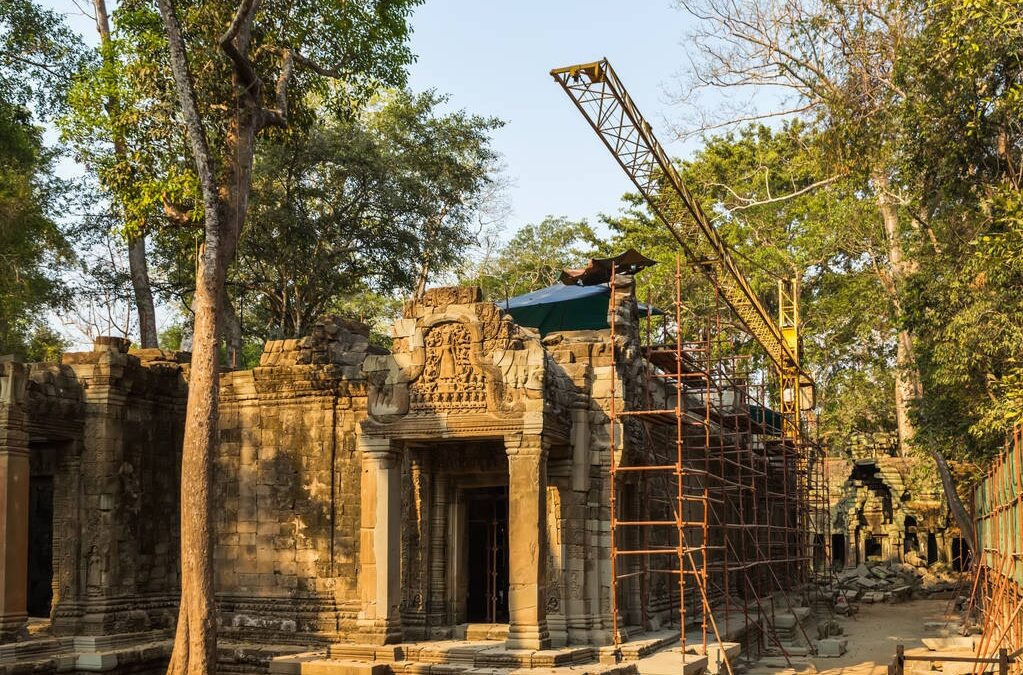
Angkor Wat is not just being preserved in one big project.
It is being cared for through many smaller, careful restoration efforts across the temple and the wider Angkor Archaeological Park.
As of 2026, the newest reported Angkor Wat specific update is the completed restoration of the north library on the second level of Angkor Wat. APSARA National Authority reported that the work began in November 2025 and finished in 2026.
Another major recent project is the restoration of the causeway on Angkor Wat’s second terrace, which began in early November 2024. That work includes repairing damaged sandstone, replacing missing pieces, removing poor older cement repairs, and restoring Naga balustrades and pillars closer to their original layout.
So yes, Angkor Wat is still ancient.
But the care behind it is very active and very modern.
And honestly, that is part of what makes the site so impressive. You are not only seeing a temple from the 12th century. You are seeing a living heritage site that still needs expert hands, patient repair work, and a lot of people who really know their sandstone.
Quick Answer
The latest Angkor Wat restoration efforts include the completed restoration of the north library on Angkor Wat’s second level, ongoing work on the second terrace causeway, repair of damaged sandstone, removal of old cement repairs, restoration of Naga balustrades, stone strengthening, water management projects around Angkor, and continued international coordination through APSARA National Authority, UNESCO, ICC Angkor, and partner teams.
Key Takeaways
- The north library on Angkor Wat’s second level was restored between November 2025 and March 2026.
- The second terrace causeway restoration began in early November 2024.
- APSARA National Authority leads much of the conservation work at Angkor Wat.
- Recent causeway work includes fixing cracked pillars, broken floor stones, missing pedestals, and Naga balustrades.
- Older cement repairs are being removed where they harm or weaken the original stonework.
- New sandstone is used only where missing or badly damaged elements need replacement.
- Experts are using stone strengthening, structural repair, documentation, and careful dismantling where needed.
- UNESCO and ICC Angkor continue to review and coordinate conservation work across Angkor.
- Water management is also part of protecting Angkor because flooding, drainage, and moisture can damage ancient structures.
Latest Angkor Wat Restoration Work at a Glance
| Restoration Area | Latest Status | Main Work | Why It Matters |
|---|---|---|---|
| North library on the second level | Completed in March 2026 | Stone strengthening, roof repair, wall repair, foundation repair, Apsara carving protection | It reopens attention to a part of Angkor Wat that had been closed for safety reasons |
| Second terrace causeway | Work reported from early November 2024 onward | Repairing cracked stone, replacing missing sandstone, correcting older repairs, restoring Naga balustrades | The causeway is part of the visitor route and temple structure |
| Stone conservation | Continuing across damaged areas | Strengthening decayed stone and stabilising weak parts | It helps stop loose, cracked, or worn stone from getting worse |
| Bas-relief conservation | Long-running work at Angkor Wat | Cleaning, stabilising, water control, and surface protection | The carvings hold some of the most valuable art and stories at the temple |
| Water management around Angkor | Active projects reported in 2026 | Restoring ancient canals, improving drainage, reducing flood pressure | Water control helps protect temples, landscapes, and nearby communities |
| International coordination | Continuing through UNESCO and ICC Angkor | Expert reviews, technical advice, training, and project oversight | It keeps restoration work careful, consistent, and well reviewed |
Who Is Leading Angkor Wat Restoration?
The main local body responsible for Angkor Wat conservation is APSARA National Authority.
APSARA manages and protects Angkor Archaeological Park, including Angkor Wat, Angkor Thom, Bayon, Ta Prohm, and many other temples and ancient structures.
But Angkor restoration is not done by one group alone.
It is a team effort involving Cambodian specialists, UNESCO, ICC Angkor, foreign conservation groups, universities, and technical experts from different countries.
That matters because Angkor Wat is too large, too delicate, and too historically rich for simple repair work.
You cannot just glue a stone back on and hope for the best.
Well, you could, but that would be a terrible idea.
Proper restoration needs archaeology, engineering, stone science, water management, documentation, local knowledge, and respect for the original Khmer structure.
The Newest Reported Project at Angkor Wat
The newest reported Angkor Wat specific restoration update is the north library on the second level of Angkor Wat.
APSARA National Authority reported in April 2026 that the restoration was completed in March 2026. The project began in November 2025 and focused on strengthening damaged parts of the library.
Before the work, the area had been closed to visitors for safety reasons. Loose and weakened stones created a risk, especially around the structure and roof.
The restoration focused on:
- Strengthening decayed stone.
- Repairing foundation areas.
- Stabilising walls.
- Repairing roof stones.
- Protecting bas-reliefs and Apsara carvings.
- Improving the structure so it can better carry weight.
APSARA also reported that a pilot solution was being used with two supporting pillars to help distribute weight and add strength to the structure.
That may not sound dramatic, but it is exactly the kind of careful work that keeps ancient buildings standing.
Heritage repair is not always glamorous. Sometimes the big win is simply stopping a very old stone from falling on someone’s head.
Why the North Library Restoration Matters
The north library restoration matters because it protects part of Angkor Wat that visitors had not been able to access safely for years.
The library is not just a side building with pretty stonework.
It helps explain the layout, use, and sacred design of Angkor Wat. It also contains carvings and architectural features that give visitors a deeper look at the temple’s design.
After the restoration, visitors may be able to better appreciate:
- The role of library structures inside Khmer temple design.
- The repaired stonework on the second level.
- Apsara bas-reliefs that had been at risk from decay.
- The way smaller structures support the full temple layout.
This is a good example of why restoration is not only about saving the famous towers.
Angkor Wat is made of many parts.
If the smaller pieces are ignored, the story becomes thinner.
The Second Terrace Causeway Project
Another major Angkor Wat restoration effort is the causeway on the second terrace.
APSARA reported that this project began in early November 2024. The area had suffered from cracked pillars, broken stones, damaged flooring, missing pedestals, and broken Naga balustrades.
The causeway had also been repaired in earlier periods, but some of that work had weakened over time. In some places, cement repairs from the past were no longer helping and needed to be removed.
The current repair work includes:
- Dismantling damaged sections where needed.
- Repairing broken sandstone.
- Removing older cement repairs.
- Replacing missing pedestals.
- Replacing missing pillars and floor stones.
- Restoring Naga balustrade sections.
- Returning moved elements to their proper positions.
- Studying the original structure before putting pieces back.
This is slow work.
And it should be.
When you are dealing with a 12th century temple, speed is not the flex. Accuracy is.
Why Removing Old Cement Repairs Matters
One of the most useful parts of the newer restoration work is the removal of harmful old cement repairs.
In the past, cement was often used to patch damaged ancient stone. It may have seemed practical at the time, but cement can cause problems because it behaves differently from sandstone.
It can trap moisture, create stress, look out of place, and make later repairs harder.
Modern conservation usually tries to use materials and methods that are closer to the original structure and easier to review in the future.
That is why removing old cement can be a big step forward.
It is not just about making the temple look better.
It is about stopping repair work from causing more damage later.
New Sandstone Is Used Carefully
New sandstone is being used in some areas of the causeway restoration.
But this does not mean workers are simply replacing old Angkor Wat with new stone.
Good restoration tries to keep original material wherever possible. New stone is used when pieces are missing, badly damaged, or needed for structural stability.
That balance is important.
If too much new material is used, the site can lose its historical feel. If too little is done, the structure may stay unsafe or keep falling apart.
So the goal is careful repair, not a shiny remake.
Angkor Wat should still look and feel ancient.
It should just be ancient in a way that does not collapse.
Naga Balustrade Restoration
Naga balustrades are a major part of Khmer temple architecture.
At Angkor Wat, the Naga form is not just decorative. It is part of the temple’s sacred and symbolic design.
Recent restoration on the second terrace causeway includes work on broken or missing Naga balustrade sections.
This matters for three reasons.
- The balustrades help define the path through the temple.
- They carry religious and artistic meaning.
- They are part of the structure visitors actually see and move around.
When these pieces are repaired properly, the causeway becomes safer and closer to its original design.
It also helps visitors understand the temple as a complete sacred route rather than a random collection of broken stone.
Stone Strengthening and Surface Repair
Stone conservation is one of the most important parts of Angkor Wat restoration.
Sandstone can crack, flake, decay, shift, and weaken over time. Heat, rain, moisture, biological growth, visitor pressure, and earlier repairs can all play a part.
Recent work at the north library included strengthening decayed stone across foundations, walls, roof areas, doorframes, pillars, and carvings.
This type of work often looks quiet from the outside.
You may not see a giant crane or huge scaffolding tower.
But it is some of the most valuable work happening at the site because weak stone can get worse quickly if it is ignored.
Restoration teams have to treat each piece like part of a puzzle and part of a patient.
A very old, very heavy patient.
Bas-Relief and Carving Protection
Angkor Wat’s carvings are one of its greatest treasures.
The temple includes long bas-relief galleries showing Hindu stories, royal scenes, battles, gods, demons, heavens, hells, and daily details from the Khmer world.
One of the best-known conservation areas is the Churning of the Ocean of Milk Gallery. This gallery contains one of Angkor Wat’s most famous bas-reliefs and has long needed expert care because of water, salt, stone decay, and surface damage.
Protecting carvings is hard because the surface itself is the artwork.
You cannot just replace a carved wall and call it fixed.
Conservators need to clean, stabilise, study, and protect the stone without damaging the original surface.
That is slow, detailed work.
Basically, it is the opposite of pressure washing your patio.
Water Management Is Part of Restoration Too
When people think about Angkor Wat restoration, they often picture workers repairing stones.
But water management is also a huge part of protecting Angkor.
Angkor is not only a collection of temples. It is also an ancient landscape with canals, reservoirs, moats, dykes, roads, and water systems.
APSARA and New Zealand have worked through the Angkor Water Resilience Project to restore ancient canals and improve water control around Angkor. In 2026, APSARA reported restoration of two ancient canals in Daun Keo Commune with a combined length of 4,390 metres, completed in November 2025.
This type of work helps with:
- Flood control.
- Drainage around the Angkor region.
- Protection of cultural landscapes.
- Water storage for local communities.
- Better care for the wider ancient hydraulic system.
This matters because water can damage temples if it is not managed well.
Too much water can weaken foundations, flood paths, move soil, and speed up stone decay. Too little water can also affect the landscape and community life around Angkor.
So yes, restoring canals can help protect temples too.
Not as dramatic as fixing a tower, but very useful.
UNESCO and ICC Angkor Still Play a Major Role
UNESCO and ICC Angkor remain central to the protection of Angkor.
ICC Angkor helps coordinate conservation projects, review technical work, and bring together national and international experts.
In December 2025, UNESCO reported that more than 300 participants joined ICC Angkor and Sambor Prei Kuk sessions in Siem Reap. These meetings reviewed conservation work, shared technical updates, and discussed the future of heritage protection at Cambodia’s World Heritage sites.
This kind of coordination is not just paperwork.
It helps stop restoration work from becoming random, rushed, or inconsistent.
When many teams work across one huge site, someone needs to make sure the methods, goals, and safety standards fit together.
That is where expert review matters.
Why International Support Still Matters
Angkor restoration has been shaped by international support for decades.
Teams from Cambodia and other countries have worked on conservation, documentation, training, structural repair, archaeology, water management, and visitor planning.
That support matters because Angkor is enormous.
UNESCO describes Angkor Archaeological Park as covering about 400 square kilometres and containing temples, hydraulic structures, roads, reservoirs, canals, and remains of old Khmer capitals.
That is not one repair site.
That is a whole ancient world.
International support helps bring money, equipment, scientific methods, and training. Cambodian teams bring local knowledge, long-term site responsibility, and cultural connection.
The best restoration work needs both.
What Visitors Might Notice During Restoration
If you visit Angkor Wat while restoration work is happening, you may notice a few things.
- Scaffolding around certain areas.
- Sections closed for safety.
- Workers cleaning or studying stones.
- Temporary barriers around fragile areas.
- Stone blocks being numbered or organised.
- Information signs near active work zones.
This can be slightly annoying if part of your photo is blocked.
But it is also a good sign.
It means the temple is being cared for rather than left to wear down quietly.
And let’s be honest, Angkor Wat is still more impressive with a bit of scaffolding than most places are at their best.
Will Restoration Affect Your Visit?
Usually, restoration will not ruin your visit to Angkor Wat.
Most work affects specific sections, not the whole temple. You can still see the main towers, moat, causeway, galleries, and major temple areas unless a temporary safety closure is in place.
That said, access can change.
A small area that was open last month might be closed this month. A repaired area may reopen after years of being off limits. Work schedules can also change because of weather, safety, or technical findings.
Before you visit, check current site updates if you are hoping to see a very specific section.
For most visitors, the better mindset is simple.
Expect a living heritage site, not a frozen museum.
Why Angkor Wat Needs Constant Restoration
Angkor Wat needs constant care because it is old, huge, exposed, and heavily visited.
The temple faces several kinds of pressure.
- Rain and moisture.
- Heat and weather changes.
- Stone decay.
- Plant growth.
- Past repair materials that no longer work well.
- Tourism pressure.
- Ground movement and water flow.
- Natural aging of sandstone and laterite.
This does not mean Angkor Wat is falling apart tomorrow.
It means old stone needs regular care.
Think of it like owning a house from the 1100s, except the house is a giant sacred temple visited by people from all over the world.
So yes, maintenance is going to be a thing.
How Restoration Teams Decide What to Repair
Restoration teams do not just walk around pointing at random stones.
They study the structure first.
They look at old photographs, past repair records, stone positions, cracks, water damage, missing pieces, and safety risks. They may number stones, document blocks, map damage, and compare current conditions with older records.
Then they decide what needs repair, what can stay as it is, and what should be left untouched.
The goal is not to make Angkor Wat look new.
The goal is to keep it stable, readable, and honest to its history.
That is a hard balance.
Too little work, and damage gets worse.
Too much work, and the temple starts to lose its old character.
What Makes Angkor Wat Restoration Difficult?
Angkor Wat restoration is difficult because every repair has to respect the original structure.
Some stones are cracked but still original. Some pieces have moved. Some areas were repaired long ago with materials that are now causing problems. Some carvings are fragile. Some foundations need strengthening without disturbing the layout above.
Restoration teams have to solve problems like:
- How to support weak stone without hiding it.
- How to replace missing pieces without overdoing it.
- How to remove harmful old repairs without damaging the original stone.
- How to keep visitors safe during work.
- How to protect sacred meaning as well as physical structure.
- How to manage water, plants, and weather.
It is part science, part history, part engineering, and part patience.
A lot of patience.
Restoration Does Not Mean Rebuilding Everything
One thing visitors sometimes misunderstand is what restoration means.
Restoration does not mean rebuilding Angkor Wat to look brand new.
That would be wrong.
Angkor Wat’s age is part of its value. The worn stone, faded carvings, missing pieces, and weathered surfaces all tell part of the story.
Good conservation tries to protect what remains, repair what is at risk, and avoid fake perfection.
That is why some broken or worn areas may still look broken or worn after restoration.
The goal is not to erase time.
The goal is to stop time from winning too fast.
How Restoration Helps Local Visitors and Tourists
Restoration helps visitors in practical ways.
It can reopen closed areas, make walkways safer, protect carvings, reduce the risk of falling stones, and make the site easier to understand.
The north library project is a good example. APSARA said the area had been closed because of safety concerns. After restoration, it can become a new point of interest for visitors who want to understand more than just the famous central towers.
That matters because Angkor Wat has more to offer than the sunrise photo.
Yes, the sunrise is beautiful.
But the temple’s deeper value is in the details.
What Restoration Means for Cambodia
For Cambodia, Angkor Wat restoration is about more than tourism.
Angkor Wat is a national symbol, a sacred place, a cultural landmark, and one of the strongest links to the Khmer Empire.
Keeping it safe means protecting Cambodian heritage.
It also supports jobs, training, research, local pride, and cultural education. Every restored section adds knowledge and helps Cambodian experts build skills for future conservation work.
This is especially important because Angkor is not a short-term project.
It will need care for generations.
Latest Restoration Efforts Compared
| Project | Main Problem | Repair Method | Visitor Impact |
|---|---|---|---|
| North library on second level | Weak stones, damaged roof, unstable structure, safety closure | Stone strengthening, roof repair, foundation work, pilot support pillars | Potential new visitor interest after years of restricted access |
| Second terrace causeway | Cracked pillars, broken flooring, missing pedestals, damaged Naga balustrades | Careful dismantling, sandstone replacement, removal of old cement, position correction | Some work areas may be limited while repairs happen |
| Bas-relief conservation | Water, salt, surface wear, stone decay | Cleaning, stabilising, monitoring, moisture control | Helps protect famous carvings for future visitors |
| Water system restoration | Flooding, drainage pressure, damaged ancient canals | Canal repair, water gates, spillways, embankment work | Better long-term protection for the Angkor landscape |
| UNESCO and ICC Angkor coordination | Many teams working across a huge site | Expert review, technical standards, shared planning | Better managed conservation and safer long-term planning |
Common Myths About Angkor Wat Restoration
Myth One Angkor Wat Is Already Fully Restored
No.
Angkor Wat is constantly monitored and repaired. Some areas have been restored, some are being worked on, and some will need care later.
Myth Two Restoration Means Making the Temple Look New
No again.
Good restoration protects original material and keeps the historic character of the temple. It should not make Angkor Wat look like a modern replica.
Myth Three Only Foreign Experts Restore Angkor Wat
Not true.
Cambodian experts and APSARA teams play a central role. International teams support, train, advise, and work with local professionals.
Myth Four Scaffolding Means the Site Is in Bad Condition
Not always.
Scaffolding can mean planned care, safety work, documentation, or repair in one section. It does not mean the whole temple is unsafe.
Myth Five Restoration Is Only About Stones
No.
Restoration also includes drainage, water management, visitor safety, research, documentation, local training, and protection of the wider cultural landscape.
Tips for Visiting During Restoration Work
- Check current access if you want to see a specific area.
- Do not cross barriers or blocked paths.
- Give workers space and do not interrupt active repair work.
- Do not touch loose stones, carved surfaces, or numbered blocks.
- Remember that some closures are for safety, not inconvenience.
- Take time to read signs because they may explain what is being repaired.
- Hire a good local guide if you want to understand the work in more detail.
Restoration can actually make your visit more interesting.
You get to see how much work goes into keeping Angkor Wat alive.
That is not something you get from a postcard.
Why These Latest Efforts Matter
The latest Angkor Wat restoration efforts matter because they protect both the famous parts and the quieter parts of the temple.
Most people know the central towers.
Fewer people think about libraries, causeways, balustrades, roof stones, drainage, and hidden structural stress.
But those details are what keep the whole site standing.
Restoring Angkor Wat is like caring for a giant stone body. The face may be famous, but the bones, joints, and circulation matter too.
That is why the latest work is so valuable.
It protects the temple as a full sacred landscape, not just as a photo spot.
Final Thoughts
The latest Angkor Wat restoration efforts show that conservation is still very active.
The north library on the second level was restored from November 2025 to March 2026. The second terrace causeway project continues to address damaged pillars, floor stones, pedestals, and Naga balustrades. Bas-relief conservation, stone strengthening, water management, and expert review through UNESCO and ICC Angkor all remain part of the wider protection work.
That is the real story.
Angkor Wat has survived for centuries, but it has not survived by accident.
It needs care, skill, money, patience, and respect.
And every careful repair helps make sure future visitors can stand in front of those towers and feel the same thing people feel today.
A little amazed.
A little small.
And maybe a bit grateful that someone knows exactly how to save 900-year-old sandstone without messing it up.