
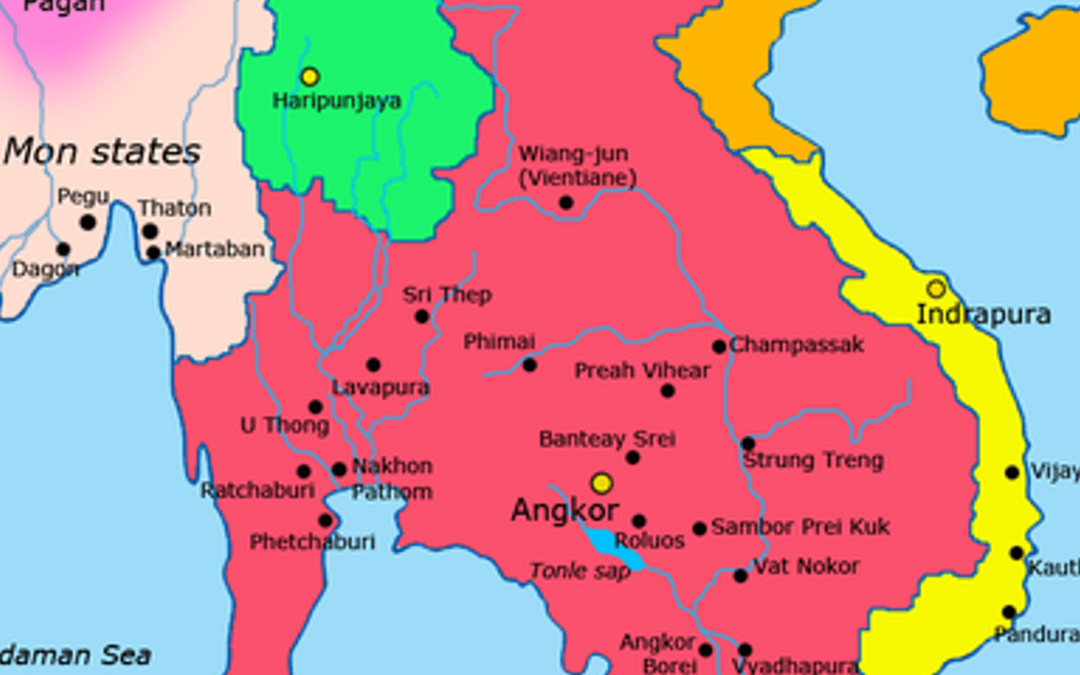
The ancient Khmer Empire did not fall because of one single disaster.
It was more like a slow collapse caused by military attacks, climate stress, water system failure, religious change, political weakness, and a shift in trade. Basically, the empire got hit from every direction at once. Not ideal when you’re trying to run one of the biggest powers in Southeast Asia.
The final capture of Angkor by Ayutthaya in 1431 is often used as the marker for the end of Angkor’s power. But the empire had already been weakening for a long time before that.
So if you’re asking what caused the fall of the Khmer Empire, the honest answer is this.
It was not just war. It was not just weather. It was not just religion. It was all of those things piling up until Angkor could no longer hold its old place as the centre of Khmer power.
Key Takeaways
- The Khmer Empire declined slowly rather than collapsing overnight.
- Repeated attacks from Thai kingdoms weakened Angkor’s military power.
- Climate swings brought long droughts followed by heavy monsoon rains.
- Angkor’s huge water system struggled under the pressure of floods, droughts, silt, and damage.
- The shift to Theravada Buddhism changed how people viewed kings, temples, and social power.
- Trade and political focus moved south toward the Phnom Penh area.
- Internal conflict made it harder for Khmer rulers to respond to outside threats.
- Angkor was not completely forgotten, but it stopped being the main political centre of the Khmer world.
Main Causes at a Glance
| Cause | How It Hurt the Empire | Why It Mattered |
|---|---|---|
| Military attacks | Thai kingdoms raided and later captured Angkor | Angkor became harder to defend |
| Climate stress | Droughts and heavy rains damaged farming and water control | Food supply and city life became less stable |
| Water system failure | Canals, reservoirs, and dykes became harder to manage | Angkor depended on water control to support its population |
| Religious change | Theravada Buddhism weakened older royal and temple traditions | The king’s sacred authority became less powerful |
| Political instability | Power struggles made strong leadership harder | The empire could not react well to repeated crises |
| Trade shift | Power moved toward river and sea trade in the south | Phnom Penh became more useful than inland Angkor |
A Quick Timeline of the Khmer Empire’s Decline
| Period | What Happened | Why It Was a Problem |
|---|---|---|
| 1177 | Cham forces attacked Angkor | It showed the capital was not untouchable |
| Late 1100s | Jayavarman VII rebuilt power and promoted Buddhism | The empire recovered, but its religious and political life was changing |
| 1200s | Thai kingdoms became stronger | Khmer control over outer regions weakened |
| 1300s | Droughts, floods, and raids placed more pressure on Angkor | The city became harder to feed, defend, and maintain |
| 1369 and 1389 | Tai attacks on Angkor were recorded | The old capital faced repeated military danger |
| 1431 | Ayutthaya captured Angkor | This is often treated as the end of Angkor’s time as the Khmer centre of power |
| After 1431 | Khmer political power shifted south | Phnom Penh and nearby regions became more central to trade and government |
There Was No Single Cause
The fall of the Khmer Empire is often explained too simply.
Some people say it was because Ayutthaya captured Angkor. Others blame climate change. Others point to religion or weak kings.
The truth is less tidy.
Each of those factors mattered, but none of them explains the full story on its own. The empire’s decline was a chain reaction. One problem made the next problem worse.
For example, drought hurt farming. Poor harvests made it harder to support workers. Fewer workers made it harder to repair canals and reservoirs. Damaged water systems then made the next drought or flood even worse.
Now add military raids, political pressure, and changing trade routes on top.
That is how a mighty empire starts to crack.
Military Pressure from Thai Kingdoms
Military pressure was one of the biggest reasons Angkor lost power.
For centuries, the Khmer Empire controlled large parts of mainland Southeast Asia. But by the 13th and 14th centuries, powerful Thai kingdoms were growing to the west.
Sukhothai and later Ayutthaya challenged Khmer control. These kingdoms did not just appear politely at the border and ask if anyone fancied sharing power. They raided, expanded, and pushed into areas that had once been under Khmer influence.
Angkor faced recorded Tai attacks in 1369, 1389, and 1431. The 1431 attack by Ayutthaya is the one most often remembered because it led to the capture of Angkor.
That did not mean every Khmer person vanished from Angkor the next morning. History is rarely that neat.
But it did mean Angkor was no longer secure enough to remain the main seat of power. A capital city that cannot protect itself has a serious problem. A capital city that gets attacked again and again has an even bigger one.
The Earlier Cham Attack Showed Angkor Could Be Beaten
The 1177 Cham attack is worth mentioning because it showed a weakness before the later decline.
Cham forces attacked Angkor by water, killed the Khmer king, and shocked the empire. Jayavarman VII later defeated the Chams and restored Khmer power, but the attack proved something scary.
Angkor could be reached.
It could be attacked.
It could be damaged.
That matters because empires often rely on the idea that the centre is safe. Once that idea breaks, enemies become bolder and rulers must spend more energy defending power instead of building it.
Climate Stress Made Everything Harder
Climate stress was another major cause of the Khmer Empire’s decline.
Angkor depended heavily on water management. Its canals, moats, reservoirs, and dykes helped control water for farming and city life. In good years, this system was brilliant. It supported rice farming, helped manage seasonal rains, and allowed a huge population to live around Angkor.
But a system that big can become fragile.
Research suggests Angkor faced long droughts mixed with sudden heavy monsoon rains. That is a horrible combination for a city built around carefully managed water.
Drought means too little water.
Heavy monsoon flooding means too much water.
Angkor had to deal with both.
Imagine trying to fix a leaking roof during a flood, then being told the house will have no water for the next few years. That is the kind of chaos Angkor’s water system faced, just on a giant ancient city scale.
How Droughts Hurt Angkor
Droughts would have hit Angkor in several ways.
- Rice farming became less reliable.
- Reservoirs stored less water.
- Food shortages became more likely.
- People may have moved away in search of better land.
- The government had fewer resources to maintain public works.
This was a huge deal because Angkor was not a small village with a few ponds. It was a massive urban centre with a water system that needed constant care.
If the water system worked, Angkor could thrive.
If it failed, everything became harder.
How Heavy Rains Made the Damage Worse
Heavy monsoon rains created the opposite problem.
Too much water could damage canals, erode banks, flood roads, and carry silt into reservoirs. When forests were cleared for farming, rain could wash more soil into the water system. That silt could build up and block channels.
Once canals and reservoirs started clogging, the system became weaker.
Then the next flood caused even more damage.
Then the next drought made the weakened system less useful.
It was a nasty cycle.
The Khmer were excellent builders and engineers, but even excellent engineering has limits. Especially when nature keeps throwing buckets of water at you, then taking all the water away.
The Water System Was a Strength and a Weakness
Angkor’s water network was one of its greatest achievements.
It helped the empire grow, feed people, support temples, and manage the seasonal rhythm of rain and dry months.
But over time, that same system became difficult to maintain.
Large canals, dykes, moats, and reservoirs need workers. They need planning. They need repairs. They need stable leadership. They also need the climate to behave within a range the system can handle.
When war, drought, flooding, and political problems arrived together, maintenance became much harder.
This is one of the big lessons from Angkor.
A system can be impressive and fragile at the same time.
Religious Change Weakened the Old Power Structure
The shift toward Theravada Buddhism also changed Khmer society.
Earlier Khmer kings were tied closely to Hindu and Mahayana Buddhist ideas of sacred kingship. Temples, rituals, priests, and royal ceremonies helped support the king’s authority.
In simple terms, religion helped make the king look powerful, chosen, and connected to the divine.
Theravada Buddhism offered a different way of thinking. It placed more focus on personal merit, monks, simplicity, and spiritual practice. That did not automatically destroy the empire, but it did change the social world that supported Angkor’s old rulers.
Huge temple building became less central.
The old priestly families lost influence.
The king’s image as a divine ruler became less powerful.
That shift mattered because Angkor had been built around royal power, temple labour, and sacred kingship. When those ideas weakened, the political system underneath them became less steady.
Did Buddhism Cause the Fall of the Khmer Empire?
No, Buddhism did not cause the fall by itself.
That would be too simple and unfair.
Theravada Buddhism changed Khmer society, but it was not some magic button that made Angkor collapse. Other Theravada Buddhist kingdoms stayed strong, including Ayutthaya, which became one of Angkor’s main rivals.
The better answer is that religious change weakened some older structures of Khmer royal power at the same time as the empire was already under pressure from war, climate, and trade changes.
So Buddhism was part of the shift, not the whole cause.
Political Instability Made Problems Harder to Fix
Strong leadership matters most during a crisis.
Unfortunately for Angkor, the later Khmer Empire faced internal pressure, rival claims, and weaker central control. When leaders are fighting each other or struggling to hold the empire together, it becomes harder to solve big problems.
And Angkor had plenty of big problems.
- Border attacks needed military response.
- Water systems needed repair.
- Farmers needed stable harvests.
- Trade routes needed protection.
- Religious change needed careful handling.
That is a lot for any government.
When political control weakens, even fixable problems can become dangerous. A broken canal is bad. A broken canal during drought, after a raid, with a weak court and fewer workers is much worse.
That is the pattern you see in Angkor’s decline.
Economic Pressure and the Shift Toward Trade
The Khmer Empire was built around inland power.
Angkor’s wealth depended heavily on rice farming, labour control, temples, and the water system. That worked very well for a long time.
But Southeast Asian trade was changing.
River and sea trade became more valuable. Places closer to the Mekong and coastal trade routes had advantages that inland Angkor did not.
This helped pull Khmer power south toward the Phnom Penh area.
Phnom Penh sat in a better position for trade because it was linked to major waterways. That made it more useful in a world where commerce was moving through rivers and maritime routes.
In other words, Angkor did not just lose power because it was attacked. It also became less useful as the main economic centre.
That is a quiet kind of decline, but it matters.
Why People Moved Away from Angkor
People likely moved away from Angkor for practical reasons.
If farming became less reliable, military attacks increased, water systems failed, and trade opportunities improved elsewhere, moving made sense.
People follow safety, food, work, and money. Ancient people were not different from us in that way.
A family living near Angkor may not have cared about the grand theory of empire decline. They cared about whether crops grew, whether soldiers came, whether water arrived, and whether their children were safe.
When those things became less secure, moving south was a reasonable choice.
That slow movement of people helped reduce Angkor’s power even more.
Was Angkor Completely Abandoned?
No, Angkor was not completely abandoned in the way people often imagine.
The image of a lost jungle city can be exciting, but it is not fully accurate.
Angkor lost its role as the main political centre, but religious life continued in parts of the site. Monks and local communities kept connections to Angkor Wat and other sacred places.
That is why Angkor Wat remained better preserved than many other temples.
It still mattered.
It was no longer the heart of a giant empire, but it did not simply vanish from memory.
Why 1431 Matters
The year 1431 matters because Ayutthaya captured Angkor.
This event is often used as the dividing line between the Angkor period and the post-Angkor period. It was a major blow to Khmer power and helped push the court south.
But you should not think of 1431 as the moment everything suddenly collapsed from perfect strength to total ruin.
By then, Angkor had already been weakened for generations.
The capture of Angkor was the dramatic ending people remember. The deeper decline had been happening for a long time.
It is a bit like watching a tree fall in a storm. The crash is sudden, but the roots may have been weakening for years.
The Fall of the Khmer Empire Was Really a Shift in Power
When people talk about the fall of the Khmer Empire, they often picture total destruction.
But it is better to think of it as a major shift in power.
Angkor lost its role as the political centre. The Khmer court moved south. The old temple-building system faded. Trade became more important than massive inland waterworks. Theravada Buddhism became central to Cambodian life.
So the empire did fall, but Cambodia did not end.
Khmer culture continued. Cambodian kings continued. Buddhist worship continued. Angkor remained sacred and powerful in memory.
The old imperial system broke, but the Khmer people did not disappear.
What Was the Biggest Cause of the Khmer Empire’s Fall?
The biggest cause was the combined pressure of war, climate stress, and internal weakness.
If you had to choose the most damaging mix, it would be this.
- Military attacks made Angkor unsafe.
- Climate swings damaged food and water systems.
- Political and religious changes made the old royal system weaker.
- Trade moved power toward the south.
Those causes fed into each other.
A strong empire might survive one of them.
Angkor had to face all of them.
That is why the fall feels so complex. It was not a single punch. It was years of pressure from every side.
Common Myths About the Fall of the Khmer Empire
Myth One Angkor Fell Only Because of War
War mattered a lot, but it was not the only cause.
Ayutthaya’s capture of Angkor in 1431 was a major event, but climate stress, water system failure, trade changes, and political weakness had already damaged the empire.
Myth Two Climate Change Alone Destroyed Angkor
Climate stress played a major role, but it was not acting alone.
Drought and flooding hurt Angkor because the city depended on a huge water system, farming, labour, and stable rule. Climate made existing problems worse.
Myth Three Everyone Left Angkor Forever
No.
Angkor declined as a capital, but people still lived in the region and Buddhist worship continued. Angkor Wat remained an active sacred site.
Myth Four Theravada Buddhism Destroyed the Empire
No.
Theravada Buddhism changed the social and political structure, but it did not destroy the empire by itself. It was one part of a much bigger change.
Why the Khmer Empire’s Fall Still Matters
The fall of the Khmer Empire still matters because it shows how even advanced societies can struggle when several systems fail at the same time.
Angkor had amazing temples, powerful kings, skilled engineers, and a massive water network. It was not weak in any simple way.
But it depended on balance.
It needed steady water. It needed strong leadership. It needed safe borders. It needed enough workers. It needed a political system people still believed in.
When that balance broke, the empire could not keep its old shape.
That is the real lesson.
The Khmer Empire did not fall because it lacked greatness. It fell because greatness can still be vulnerable when the world around it changes too fast.
Final Thoughts
The fall of the ancient Khmer Empire was caused by several problems working together.
Military attacks weakened Angkor from the outside. Climate swings damaged farming and water systems from within. Religious change reshaped society. Political struggles made strong responses harder. Trade moved power south toward Phnom Penh.
By the time Ayutthaya captured Angkor in 1431, the old capital had already been under pressure for a long time.
So the best answer is not that Angkor was beaten by one enemy or ruined by one flood.
The Khmer Empire fell because its whole system became harder and harder to hold together.
And that is what makes the story so powerful. Angkor was one of the greatest cities of the medieval world, but even a city of temples, towers, canals, and kings could not survive every pressure at once.